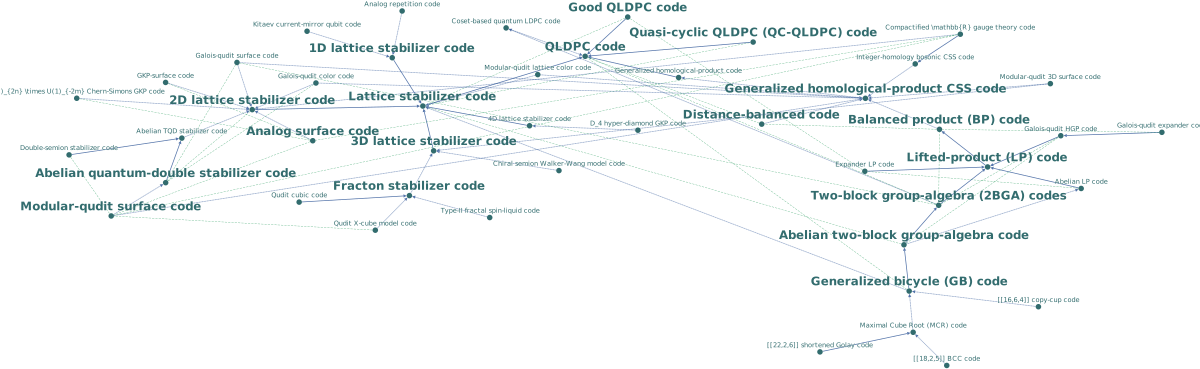
Here is a list of non-qubit QLDPC codes. For the list of qubit QLDPC codes, see Qubit QLDPC codes.
| Code | Description |
|---|---|
| 1D lattice stabilizer code | Lattice stabilizer code in one Euclidean dimension, using either the ordinary block notion of locality or the fermionic/Majorana notion of locality. |
| 2D lattice stabilizer code | Lattice stabilizer code in two Euclidean dimensions, using either the ordinary block notion of locality or the fermionic/Majorana notion of locality. |
| 3D lattice stabilizer code | Lattice stabilizer code in three Euclidean dimensions, using either the ordinary block notion of locality or the fermionic/Majorana notion of locality. |
| 4D lattice stabilizer code | Lattice stabilizer code in four Euclidean dimensions, using either the ordinary block notion of locality or the fermionic/Majorana notion of locality. |
| Abelian LP code | A lifted-product code whose lift group \(G\) is Abelian. The one-by-one (scalar) case, built from a pair of single group-algebra elements \(a,b \in \mathbb{F}_q[G]\), yields Abelian 2BGA codes. The case of \(G\) being a cyclic group is a GB code (a.k.a. a quasi-cyclic LP code) [1; Sec. III.E]. A particular family with \(G=\mathbb{Z}_{\ell}\) yields codes with parameters \([[n,k=\Theta(\log n),d=\Theta(n/\log n)]]\) [1]. |
| Abelian TQD stabilizer code | Modular-qudit stabilizer code whose codewords realize a 2D Abelian twisted-quantum-double topological order on composite-dimensional qudits. For every finite Abelian group \(G=\prod_i \mathbb{Z}_{N_i}\) and every product of Type-I and Type-II cocycles, there is a Pauli stabilizer Hamiltonian realizing the corresponding Abelian TQD [2]. Equivalently, these codes exhaust the 2D Abelian topological orders that admit gapped boundaries [2,3]. |
| Abelian quantum-double stabilizer code | Modular-qudit stabilizer code whose codewords realize 2D modular gapped Abelian topological order with trivial cocycle. The corresponding anyon theory is defined by an Abelian group. The \(G=\mathbb{Z}_2\) instance on a torus is the toric code, and cyclic-group instances reduce to modular-qudit surface codes. All such codes can be realized by a stack of modular-qudit surface codes because all finite Abelian groups are direct products of cyclic groups. |
| Abelian two-block group-algebra code | A 2BGA code LP\((a,b)\) whose group \(G\) is Abelian, equivalently a multi-dimensional index-two quasi-cyclic code. Since any finite Abelian group is a direct product of cyclic groups, the group algebra elements \(a\) and \(b\) can be treated as multivariate polynomials. The family includes GB (one variable), bivariate bicycle (two variables), and higher-variable codes, providing some of the best known short codes with small stabilizer weights. |
| Analog repetition code | An \([[n,1]]_{\mathbb{R}}\) analog stabilizer version of the quantum repetition code, encoding the position states of one mode into an odd number \(n\) of modes. |
| Analog surface code | An analog CSS version of the Kitaev surface code realizing a phase of 2D \(\mathbb{R}\) gauge theory. |
| Balanced product (BP) code | Family of CSS quantum codes obtained from two classical-code chain complexes that share a common group symmetry. The balanced product can be understood as taking the usual tensor or hypergraph product and then quotienting by the shared symmetry action. This can reduce the overall number of physical qubits \(n\) while, in favorable cases, preserving the number of encoded qubits and the code distance, thereby improving the encoding rate \(k/n\) and normalized distance \(d/n\) compared to the underlying tensor or hypergraph product. |
| Chiral semion Walker-Wang model code | A 3D lattice modular-qudit stabilizer code with qudit dimension \(q=4\) whose low-energy excitations on boundaries realize the chiral semion topological order. The model admits 2D chiral semion topological order at one of its surfaces [4,5]. The corresponding phase can also be realized via a non-stabilizer Hamiltonian [6]. |
| Compactified \(\mathbb{R}\) gauge theory code | An integer-homology bosonic CSS code realizing 2D \(U(1)\) gauge theory on bosonic modes. The code can be obtained from the analog surface code by condensing certain anyons [7]. This results in a pinning of each mode to the space of periodic functions, which is the Hilbert space of a physical rotor, and can be thought of as compactification of the 2D \(\mathbb{R}\) gauge theory phase realized by the analog surface code. |
| Coset-based quantum LDPC code | A two-block CSS code \(Q_G^H(a,b)\) built from the action of a finite group \(G\) on the left cosets \(G/H\) of a subgroup \(H\), generalizing 2BGA codes to a much larger family of quantum LDPC codes. The length \(n=2[G:H]\) is even, being twice the index of \(H\) in \(G\). |
| Distance-balanced code | Galois-qudit CSS code obtained from a CSS code by increasing the smaller of the \(X\)- and \(Z\)-distances using a homological-product-based balancing step or one of its generalizations. The initial code is said to be unbalanced, i.e., tailored to noise biased toward either bit- or phase-flip errors, and the procedure can result in a code that treats both types of errors on a more equal footing. |
| Double-semion stabilizer code | A 2D lattice modular-qudit stabilizer code with qudit dimension \(q=4\) that realizes the 2D double semion topological phase. The code can be obtained from a \(\mathbb{Z}_4\) toric-code ground state by condensing the emergent boson \(e^2 m^2\); in the stabilizer construction this condensation is implemented by two-body measurements [2,8]. Its ground-state subspace can be mapped to that of the double-semion string-net model by a finite-depth quantum circuit with ancillas [2]. |
| Expander LP code | Family of \(G\)-lifted product codes constructed using two classical expander codes, equivalently two regular Tanner codes defined on the same expander graph [9]. For certain parameters, this construction yields the first asymptotically good QLDPC codes. Classical codes resulting from the same lifted-product complexes are one of the first two families of \(c^3\)-LTCs [10]. |
| Fracton stabilizer code | A 3D modular-qudit stabilizer code whose codewords make up the ground-state space of a Hamiltonian in a fracton phase. Unlike topological phases, whose excitations can move in any direction, fracton phases are characterized by excitations whose movement is restricted. |
| GKP-surface code | A concatenated code whose outer code is a GKP code and whose inner code is a surface code, including toric surface-code variants [11,12], rotated surface codes [13–16], and XZZX surface codes [17]. |
| Galois-qudit HGP code | A member of a family of Galois-qudit CSS codes whose stabilizer generator matrix is obtained from a hypergraph product of two classical linear \(q\)-ary codes. |
| Galois-qudit color code | Extension of the color code to 2D lattices of Galois qudits. |
| Galois-qudit expander code | Galois-qudit CSS code obtained from tensor products of chain complexes associated with \(q\)-ary expander codes. |
| Galois-qudit surface code | Extension of the surface code to 2D lattices of Galois qudits. |
| Generalized bicycle (GB) code | A quasi-cyclic Galois-qudit CSS code constructed using a generalized version of the bicycle ansatz [18] from a pair of equivalent index-two quasi-cyclic linear codes. The length \(n=2\ell\), twice the circulant size \(\ell\), is necessarily even. Equivalently, the codes can be constructed via the lifted-product construction for \(G\) being a cyclic group [1; Sec. III.E]. |
| Generalized homological-product CSS code | CSS code whose properties are determined from an underlying chain complex, which often consists of some type of product of other chain complexes. |
| Generalized homological-product code | Stabilizer code whose properties are determined from an underlying chain complex, which often consists of some type of product of other chain complexes. The Qubit CSS-to-homology correspondence yields an interpretation of codes in terms of chain complexes, thus allowing for the use of various products from homology in constructing codes. |
| Good QLDPC code | Also called asymptotically good QLDPC codes. A family of QLDPC codes \([[n_i,k_i,d_i]]\) whose asymptotic rate \(\lim_{i\to\infty} k_i/n_i\) and asymptotic distance \(\lim_{i\to\infty} d_i/n_i\) are both positive. |
| Integer-homology bosonic CSS code | A bosonic stabilizer code whose physical modes have been restricted, via a single GKP stabilizer, from the space of functions on the real line to the space of periodic functions. This restriction effectively realizes a rotor on each physical mode, allowing one to construct homological rotor codes out of displacement stabilizer groups. The stabilizer group is continuous, but contains discrete components in the form of the single-mode GKP stabilizers. The homology group of the logical operators has a torsion component because the chain complexes are defined over the ring of integers, which yields codes with finite logical dimension. |
| Kitaev current-mirror qubit code | Member of the family of \([[2n,(0,2),(2,n)]]_{\mathbb{Z}}\) homological rotor codes storing a logical qubit on a thin Möbius strip. The ideal code can be obtained from a Josephson-junction [19] system [20]. |
| Lattice stabilizer code | A geometrically local stabilizer code with sites organized on a lattice modeled by the additive group \(\mathbb{Z}^D\) for spatial dimension \(D\), using either the ordinary block notion of locality or the fermionic/Majorana notion of locality. On an infinite lattice, its stabilizer group is generated by few-site Pauli-type operators and their translations, in which case the code is called translationally invariant stabilizer code. Boundary conditions have to be imposed on the lattice in order to obtain finite-dimensional versions. Lattice defects and boundaries between different codes can also be introduced. |
| Lifted-product (LP) code | Galois-qudit code that utilizes the notion of a lifted product in its construction. Lifted products of certain classical Tanner codes are the first (asymptotically) good QLDPC codes. |
| Maximal Cube Root (MCR) code | Qubit GB code whose defining polynomials guarantee a large automorphism group and many fold-transversal CX gates. The construction ties both properties to a nontrivial cube root of unity in a polynomial quotient ring [21]. |
| Modular-qudit 3D surface code | A generalization of the 3D surface code to modular qudits. Qudits are placed on edges, \(Z\)-type stabilizer generators are placed on square plaquettes oriented in all three directions, and \(X\)-type stabilizers are placed on the six edges neighboring every vertex [22]. |
| Modular-qudit lattice color code | Extension of the color code to lattices of modular qudits. Codes are defined analogously to qubit color codes on suitable lattices of any spatial dimension, but a directionality is required in order to make the modular-qudit stabilizers commute. This can be done by puncturing a hyperspherical lattice [23] or constructing a star-bipartition; see [24; Sec. III]. Logical dimension is determined by the genus of the underlying surface (for closed surfaces), types of boundaries (for open surfaces), and/or any twist defects present. |
| Modular-qudit surface code | Extension of the surface code to prime-dimensional [25,26] and more general modular qudits. Stabilizer generators are few-body \(X\)-type and \(Z\)-type Pauli strings associated to the stars and plaquettes, respectively, of a tessellation of a two-dimensional surface. Since qudits have more than one \(X\) and \(Z\)-type operator, various sets of stabilizer generators can be defined. |
| QLDPC code | Member of a family of stabilizer codes for which the number of sites participating in each stabilizer generator and the number of stabilizer generators that each site participates in are both bounded by a constant as \(n\to\infty\). Sometimes, the two parameters are explicitly stated: each site of an \((l,w)\)-regular QLDPC code is acted on by \(\leq l\) generators of weight \(\leq w\). |
| Quasi-cyclic QLDPC (QC-QLDPC) code | A QLDPC code such that cyclic shifts of the subsystems by a fixed \(\ell\geq 1\) leave the codespace invariant. Stabilizer generator matrices of such codes can be put into block form, where each nonzero block is a circulant matrix [27,28]. |
| Qudit X-cube model code | Generalization of the X-cube model code to modular qudits. |
| Qudit cubic code | Generalization of the Haah cubic code to modular qudits. |
| Two-block group-algebra (2BGA) codes | 2BGA codes are the one-by-one, or smallest, LP codes: \(LP(a,b)\) is defined by a pair of group algebra elements \(a,b\in \mathbb{F}_q[G]\), where \(G\) is a finite group. The codes have length \(n=2|G|\). |
| Type-II fractal spin-liquid code | A type-II fracton prime-qudit CSS code defined on a cubic lattice [29; Eqs. (D9-D10)]. |
| \(D_4\) hyper-diamond GKP code | Two-mode GKP qubit-into-oscillator code based on the \(D_4\) hyper-diamond lattice [30]. |
| \(U(1)_{2n} \times U(1)_{-2m}\) Chern-Simons GKP code | A non-CSS multimode GKP code defined on a 2D mode lattice that encodes a qudit logical space and whose excitations are characterized by the \(U(1)_{2n} \times U(1)_{-2m}\) Chern-Simons theory. The code can be obtained from the analog surface code by condensing certain anyons [7]. |
| \([[16,6,4]]\) copy-cup code | An even pure \([[16,6,4]]\) CSS code that admits a constant-depth logical \(CZ\) gate between two copies and is constructed as a balanced product of two weight-four cyclic group-algebra codes over \(\mathbb{F}_2[\mathbb{Z}_8]\). It is one of two inequivalent \([[16,6,4]]\) codes whose complete logical Clifford group is realizable by depth-one two-local circuits, the other being the tesseract color code. |
| \([[18,2,5]]\) BCC code | BCC code on 18 qubits encoding 2 logical qubits with distance 5, found by computer search [31]. |
| \([[22,2,6]]\) shortened Golay code | Self-dual doubly even CSS code on 22 physical qubits encoding two logical qubits with distance six. The code is constructed from the self-orthogonal \([22,10,8]\) code obtained by shortening the \([24,12,8]\) extended Golay code on two bits [32; Appx. A.1.5]. Since the automorphism group of the extended Golay code is 5-transitive, the code does not depend on which two bits are chosen [32]. The code is also a symplectic double of a pure \([[11,1,3]]\) stabilizer code. |
List: Codes that are descendants of QLDPC code and not descendants of Qubit QLDPC code.
References
- [1]
- P. Panteleev and G. Kalachev, “Quantum LDPC Codes With Almost Linear Minimum Distance”, IEEE Transactions on Information Theory 68, 213 (2022) arXiv:2012.04068 DOI
- [2]
- T. D. Ellison, Y.-A. Chen, A. Dua, W. Shirley, N. Tantivasadakarn, and D. J. Williamson, “Pauli Stabilizer Models of Twisted Quantum Doubles”, PRX Quantum 3, (2022) arXiv:2112.11394 DOI
- [3]
- J. Kaidi, Z. Komargodski, K. Ohmori, S. Seifnashri, and S.-H. Shao, “Higher central charges and topological boundaries in 2+1-dimensional TQFTs”, SciPost Physics 13, (2022) arXiv:2107.13091 DOI
- [4]
- J. Haah, “Clifford quantum cellular automata: Trivial group in 2D and Witt group in 3D”, Journal of Mathematical Physics 62, (2021) arXiv:1907.02075 DOI
- [5]
- W. Shirley, Y.-A. Chen, A. Dua, T. D. Ellison, N. Tantivasadakarn, and D. J. Williamson, “Three-Dimensional Quantum Cellular Automata from Chiral Semion Surface Topological Order and beyond”, PRX Quantum 3, (2022) arXiv:2202.05442 DOI
- [6]
- C. W. von Keyserlingk, F. J. Burnell, and S. H. Simon, “Three-dimensional topological lattice models with surface anyons”, Physical Review B 87, (2013) arXiv:1208.5128 DOI
- [7]
- J. C. Magdalena de la Fuente, T. D. Ellison, M. Cheng, and D. J. Williamson, “Topological Stabilizer Models on Continuous Variables”, Physical Review X 16, (2026) arXiv:2411.04993 DOI
- [8]
- T. D. Ellison, Y.-A. Chen, A. Dua, W. Shirley, N. Tantivasadakarn, and D. J. Williamson, “Pauli topological subsystem codes from Abelian anyon theories”, Quantum 7, 1137 (2023) arXiv:2211.03798 DOI
- [9]
- S. Hoory, N. Linial, and A. Wigderson, “Expander graphs and their applications”, Bulletin of the American Mathematical Society 43, 439 (2006) DOI
- [10]
- P. Panteleev and G. Kalachev, “Asymptotically Good Quantum and Locally Testable Classical LDPC Codes”, (2022) arXiv:2111.03654
- [11]
- K. Fukui, A. Tomita, A. Okamoto, and K. Fujii, “High-Threshold Fault-Tolerant Quantum Computation with Analog Quantum Error Correction”, Physical Review X 8, (2018) arXiv:1712.00294 DOI
- [12]
- C. Vuillot, H. Asasi, Y. Wang, L. P. Pryadko, and B. M. Terhal, “Quantum error correction with the toric Gottesman-Kitaev-Preskill code”, Physical Review A 99, (2019) arXiv:1810.00047 DOI
- [13]
- K. Noh and C. Chamberland, “Fault-tolerant bosonic quantum error correction with the surface–Gottesman-Kitaev-Preskill code”, Physical Review A 101, (2020) arXiv:1908.03579 DOI
- [14]
- M. V. Larsen, C. Chamberland, K. Noh, J. S. Neergaard-Nielsen, and U. L. Andersen, “Fault-Tolerant Continuous-Variable Measurement-based Quantum Computation Architecture”, PRX Quantum 2, (2021) arXiv:2101.03014 DOI
- [15]
- K. Noh, C. Chamberland, and F. G. S. L. Brandão, “Low-Overhead Fault-Tolerant Quantum Error Correction with the Surface-GKP Code”, PRX Quantum 3, (2022) arXiv:2103.06994 DOI
- [16]
- M. Lin, C. Chamberland, and K. Noh, “Closest Lattice Point Decoding for Multimode Gottesman-Kitaev-Preskill Codes”, PRX Quantum 4, (2023) arXiv:2303.04702 DOI
- [17]
- J. Zhang, Y.-C. Wu, and G.-P. Guo, “Concatenation of the Gottesman-Kitaev-Preskill code with the XZZX surface code”, Physical Review A 107, (2023) arXiv:2207.04383 DOI
- [18]
- D. J. C. MacKay, G. Mitchison, and P. L. McFadden, “Sparse-Graph Codes for Quantum Error Correction”, IEEE Transactions on Information Theory 50, 2315 (2004) arXiv:quant-ph/0304161 DOI
- [19]
- S. M. Girvin, “Circuit QED: superconducting qubits coupled to microwave photons”, Quantum Machines: Measurement and Control of Engineered Quantum Systems 113 (2014) DOI
- [20]
- C. Vuillot, A. Ciani, and B. M. Terhal, “Homological Quantum Rotor Codes: Logical Qubits from Torsion”, Communications in Mathematical Physics 405, (2024) arXiv:2303.13723 DOI
- [21]
- A. Davenport, J. Blue, and I. Chuang, “Generalized Bicycle Codes as Cyclic Submodules and their Automorphism Structure”, (2026) arXiv:2606.05044
- [22]
- H. Moradi and X.-G. Wen, “Universal topological data for gapped quantum liquids in three dimensions and fusion algebra for non-Abelian string excitations”, Physical Review B 91, (2015) arXiv:1404.4618 DOI
- [23]
- H. Bombin, “Gauge Color Codes: Optimal Transversal Gates and Gauge Fixing in Topological Stabilizer Codes”, (2015) arXiv:1311.0879
- [24]
- F. H. E. Watson, E. T. Campbell, H. Anwar, and D. E. Browne, “Qudit color codes and gauge color codes in all spatial dimensions”, Physical Review A 92, (2015) arXiv:1503.08800 DOI
- [25]
- A. Yu. Kitaev, “Fault-tolerant quantum computation by anyons”, Annals of Physics 303, 2 (2003) arXiv:quant-ph/9707021 DOI
- [26]
- S. S. Bullock and G. K. Brennen, “Qudit surface codes and gauge theory with finite cyclic groups”, Journal of Physics A: Mathematical and Theoretical 40, 3481 (2007) arXiv:quant-ph/0609070 DOI
- [27]
- M. Hagiwara and H. Imai, “Quantum Quasi-Cyclic LDPC Codes”, 2007 IEEE International Symposium on Information Theory 806 (2007) arXiv:quant-ph/0701020 DOI
- [28]
- K. Kasai, M. Hagiwara, H. Imai, and K. Sakaniwa, “Quantum Error Correction Beyond the Bounded Distance Decoding Limit”, IEEE Transactions on Information Theory 58, 1223 (2012) arXiv:1007.1778 DOI
- [29]
- A. Dua, I. H. Kim, M. Cheng, and D. J. Williamson, “Sorting topological stabilizer models in three dimensions”, Physical Review B 100, (2019) arXiv:1908.08049 DOI
- [30]
- B. Royer, S. Singh, and S. M. Girvin, “Encoding Qubits in Multimode Grid States”, PRX Quantum 3, (2022) arXiv:2201.12337 DOI
- [31]
- M. B. Hastings, “A Class of Cyclic Quantum Codes”, (2025) arXiv:2509.06865
- [32]
- J. Haah, M. B. Hastings, D. Poulin, and D. Wecker, “Magic state distillation with low space overhead and optimal asymptotic input count”, Quantum 1, 31 (2017) arXiv:1703.07847 DOI