\([[4,1,2]]\) Leung-Nielsen-Chuang-Yamamoto (LNCY) code[1]
Description
A four-qubit CSS stabilizer code that is the only qubit CSS code with such parameters.
A stabilizer tableau for the code is given by [2; ID 6] \begin{align} \begin{array}{cccc} X & X & I & I \\ I & I & X & X \\ Z & Z & Z & Z \end{array}~. \tag*{(1)}\end{align} The code is depicted in Fig. I.
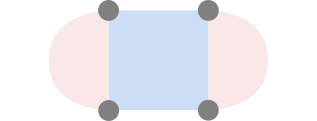
The code admits the following basis of codewords, \begin{align} \begin{split} |\overline{0}\rangle = (|0000\rangle + |1111\rangle)/\sqrt{2}~{\phantom{.}}\\ |\overline{1}\rangle = (|0011\rangle + |1100\rangle)/\sqrt{2}~. \end{split} \tag*{(2)}\end{align} It is realized as the \(\{|\overline{00}\rangle,|\overline{01}\rangle\}\) subcode of the \([[4,2,2]]\) four-qubit code [1], and the subcodes spanned by \(|\overline{00}\rangle\) and any other \([[4,2,2]]\) codeword are equivalent to it. Applying the Pauli string \(IXIX\) to its codewords yields an equivalent constant-excitation \([[4,1,2]]\) code.
The code’s \(\pm\)-basis codewords can be written as \begin{align} |\overline{\pm}\rangle = \frac{1}{2}(|00\rangle \pm |11\rangle)^{\otimes 2}~. \tag*{(3)}\end{align} Using the concatenation convention of the Zoo, this code can be viewed as a concatenation of a two-qubit phase-flip repetition code (inner code) with a two-qubit bit-flip repetition code (outer code).
Protection
Detects a single-qubit error or single erasure as a distance-two code. The code also approximately corrects a single AD error, with recovery fidelity \(1-5\gamma^2+O(\gamma^3)\) [1]. A complementary-channel analysis shows that the optimal worst-case entanglement-fidelity distance for this code under AD noise is of order \(\gamma\), improving over the uncorrected order \(\sqrt{\gamma}\), and that no recovery can improve this asymptotic scaling [3]. The \(\{|\overline{01}\rangle,|\overline{11}\rangle\}\) \([[4,1,2]]\) subcode [4] also approximately corrects a single AD error, and is a constant-excitation code.Fault Tolerance
Recursive concatenation of a \([[4,1,2]]\) error-detecting block, together with message passing across concatenation levels, yields fault-tolerant schemes; a one-dimensional nearest-neighbor architecture has a reported accuracy threshold of approximately \(10^{-5}\) per elementary operation [5,6].Realizations
Linear optical networks [7,8].Superconducting-circuit devices [9,10].Logical gates within one block [11] and between two blocks [12], with the latter interpreted as lattice surgery between planar surface codes, were realized in superconducting circuits.Neutral atom arrays by Atom Computing ran the Bernstein-Vazirani algorithm on up to 28 logical qubits [13].Break-even performance has been demonstrated on a superconducting IBM device using the syndrome-based Petz recovery [14].Implementation of a universal logical gate set in superconducting circuits by Origin Quantum Computing [15].Cousins
- \([[4,2,2]]\) Four-qubit code— The \([[4,1,2]]\) LNCY code is obtained as the \(\{|\overline{00}\rangle,|\overline{01}\rangle\}\) \([[4,1,2]]\) subcode of the \([[4,2,2]]\) four-qubit code [1]. A \(((4,3,1))_2\) jump code is a subcode of the \([[4,2,2]]\) code and contains the \([[4,1,2]]\) LNCY code as a subcode [16].
- \([[4,1,2]]\) twist-defect code— Adding \(XXII\) (\(XYZI\)) to the stabilizer group of the \([[4,2,2]]\) code yields the \([[4,1,2]]\) LNCY (twist-defect) code.
- Binomial code— The \([[4,1,2]]\) LNCY code reduces to the \(0,2,4\) binomial code when the basis labels in each codeword are written as in base-ten. Such a mapping can be generalized [17].
- Heavy-hexagon code— Magic states prepared using a \([[4,1,2]]\) subcode can be injected into the heavy-hex code [18,19]. The \(d=2\) heavy-hex code is closely related to the \([[4,1,2]]\) LNCY code.
- Cluster-state code— A \([[4,1,2]]\) LNCY code can be thought of as a cluster-state code [20].
- Quantum polar code— The \([[4,1,2]]\) LNCY code is a small quantum polar encoding [21].
- \([4,3,2]\) single parity-check (SPC) code— The \(Z\)-type stabilizer of the \([[4,1,2]]\) LNCY code is the parity check of the \([4,3,2]\) SPC code.
- Numerically optimized four-qubit AD code— The numerically optimized four-qubit AD code can correct a single AD error with higher entanglement fidelity than the \([[4,1,2]]\) LNCY code [1].
- \([[8,2,2]]\) hyperbolic color code— Up to qubit permutation, the \([[8,2,2]]\) hyperbolic color code is the symplectic double of a local-Clifford-equivalent version of the \([[4,1,2]]\) LNCY code. This version is obtained by applying the phase gate \(S\) to every qubit, so its stabilizer group is generated by \(YYII\), \(IIYY\), and \(ZZZZ\).
Member of code lists
- 2D stabilizer codes
- Approximate quantum codes and friends
- Bosonic Fock-state codes
- Concatenated quantum codes
- Constant-excitation quantum codes
- Lattice qubit stabilizer codes
- Quantum codes
- Quantum codes based on homological products
- Quantum codes with fault-tolerant gadgets
- Qubit CSS codes
- Realized quantum codes
- Small-distance qubit stabilizer codes and friends
- Surface code and friends
- Topological codes
Primary Hierarchy
References
- [1]
- D. W. Leung, M. A. Nielsen, I. L. Chuang, and Y. Yamamoto, “Approximate quantum error correction can lead to better codes”, Physical Review A 56, 2567 (1997) arXiv:quant-ph/9704002 DOI
- [2]
- Qiskit Community, “Qiskit QEC framework”, URL
- [3]
- C. Bény and O. Oreshkov, “General Conditions for Approximate Quantum Error Correction and Near-Optimal Recovery Channels”, Physical Review Letters 104, (2010) arXiv:0907.5391 DOI
- [4]
- G. Alber, Th. Beth, Ch. Charnes, A. Delgado, M. Grassl, and M. Mussinger, “Stabilizing Distinguishable Qubits against Spontaneous Decay by Detected-Jump Correcting Quantum Codes”, Physical Review Letters 86, 4402 (2001) arXiv:quant-ph/0103042 DOI
- [5]
- A. M. Stephens and Z. W. E. Evans, “Accuracy threshold for concatenated error detection in one dimension”, Physical Review A 80, (2009) arXiv:0902.2658 DOI
- [6]
- Z. W. E. Evans and A. M. Stephens, “Optimal correction of concatenated fault-tolerant quantum codes”, Quantum Information Processing 11, 1511 (2011) arXiv:0902.4506 DOI
- [7]
- C.-Y. Lu, W.-B. Gao, J. Zhang, X.-Q. Zhou, T. Yang, and J.-W. Pan, “Experimental quantum coding against qubit loss error”, Proceedings of the National Academy of Sciences 105, 11050 (2008) arXiv:0804.2268 DOI
- [8]
- B. A. Bell, D. A. Herrera-Martí, M. S. Tame, D. Markham, W. J. Wadsworth, and J. G. Rarity, “Experimental demonstration of a graph state quantum error-correction code”, Nature Communications 5, (2014) arXiv:1404.5498 DOI
- [9]
- C. K. Andersen, A. Remm, S. Lazar, S. Krinner, N. Lacroix, G. J. Norris, M. Gabureac, C. Eichler, and A. Wallraff, “Repeated quantum error detection in a surface code”, Nature Physics 16, 875 (2020) arXiv:1912.09410 DOI
- [10]
- “Exponential suppression of bit or phase errors with cyclic error correction”, Nature 595, 383 (2021) arXiv:2102.06132 DOI
- [11]
- J. F. Marques et al., “Logical-qubit operations in an error-detecting surface code”, Nature Physics 18, 80 (2021) arXiv:2102.13071 DOI
- [12]
- A. Erhard et al., “Entangling logical qubits with lattice surgery”, Nature 589, 220 (2021) arXiv:2006.03071 DOI
- [13]
- B. W. Reichardt et al., “Fault-tolerant quantum computation with a neutral atom processor”, (2025) arXiv:2411.11822
- [14]
- D. Biswas and P. Mandayam, “Universal syndrome-based recovery for noise-adapted quantum error correction”, (2026) arXiv:2510.08719
- [15]
- J. Zhang, Z.-Y. Chen, Y.-J. Wang, B.-H. Lu, H.-F. Zhang, J.-N. Li, P. Duan, Y.-C. Wu, and G.-P. Guo, “Demonstrating a universal logical gate set in error-detecting surface codes on a superconducting quantum processor”, (2024) arXiv:2405.09035
- [16]
- G. Alber, Th. Beth, Ch. Charnes, A. Delgado, M. Grassl, and M. Mussinger, “Detected-jump-error-correcting quantum codes, quantum error designs, and quantum computation”, Physical Review A 68, (2003) arXiv:quant-ph/0208140 DOI
- [17]
- L. Li, private communication, 2018
- [18]
- E. H. Chen, T. J. Yoder, Y. Kim, N. Sundaresan, S. Srinivasan, M. Li, A. D. Córcoles, A. W. Cross, and M. Takita, “Calibrated Decoders for Experimental Quantum Error Correction”, Physical Review Letters 128, (2022) arXiv:2110.04285 DOI
- [19]
- R. S. Gupta et al., “Encoding a magic state with beyond break-even fidelity”, Nature 625, 259 (2024) arXiv:2305.13581 DOI
- [20]
- C. Cafaro, D. Markham, and P. van Loock, “Scheme for constructing graphs associated with stabilizer quantum codes”, (2014) arXiv:1407.2777
- [21]
- K. Noh, “Leung code as quantum polar code”, 2017 URL
- [22]
- T. C. Ralph, A. J. F. Hayes, and A. Gilchrist, “Loss-Tolerant Optical Qubits”, Physical Review Letters 95, (2005) arXiv:quant-ph/0501184 DOI
- [23]
- Y. Ouyang, “Avoiding coherent errors with rotated concatenated stabilizer codes”, npj Quantum Information 7, (2021) arXiv:2010.00538 DOI
- [24]
- A. S. Fletcher, P. W. Shor, and M. Z. Win, “Channel-Adapted Quantum Error Correction for the Amplitude Damping Channel”, (2007) arXiv:0710.1052
Page edit log
- Victor V. Albert (2026-08-24) — most recent
- Victor V. Albert (2026-06-08)
- Victor V. Albert (2026-04-23)
Cite as:
“\([[4,1,2]]\) Leung-Nielsen-Chuang-Yamamoto (LNCY) code”, The Error Correction Zoo (V. V. Albert & P. Faist, eds.), 2026. https://errorcorrectionzoo.org/c/css_4_1_2, arXiv:2606.11484