\([[4,1,2]]\) twist-defect code[1]
Description
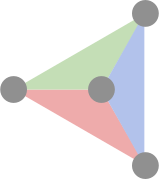
A four-qubit non-CSS stabilizer code that can be interpreted as the smallest triangular color code with \(x\)-, \(y\)-, and \(z\)-type Pauli boundaries [2; Fig. 7], and equivalently as a small twist-defect surface code on a tetrahedron inscribed in a sphere [3]. It is the only non-CSS qubit stabilizer code with parameters \([[4,1,2]]\). The code admits weight-three stabilizer generators and weight-two logical Pauli \(X,Y,Z\) operators.
A stabilizer tableau for the code is given by [4; ID 8] \begin{align} \begin{array}{cccc} X & I & X & X \\ Y & Y & I & Y \\ Z & Z & Z & I \end{array}~. \tag*{(1)}\end{align}
Stabilizer generators are shown in Fig. I.
Protection
Detects a single-qubit error or single erasure as a distance-two code.Transversal and Permutation-Based Gates
Weight-two transversal logical Pauli \(X,Y,Z\) operations [1].After a local-Clifford deformation, a cyclic qubit permutation implements a logical \(S\) gate in a suitable logical basis [5; Constr. 6]. Single-qubit Clifford gates and qubit permutations together realize the full single-qubit logical Clifford group [3,5]. The code is the unique smallest distance-two stabilizer code to realize this group up to local-Clifford and permutation equivalence [5]. In the twist-defect interpretation, these operations include braiding the four genons [3].Realizations
Logical Clifford gates were realized in a trapped-ion device by Quantinuum [3].Cousins
- \([[4,2,2]]\) Four-qubit code— Adding \(XYZI\) to the stabilizer group of the \([[4,2,2]]\) four-qubit code yields the \([[4,1,2]]\) twist-defect subcode [1].
- Toric code— The symplectic double of the \([[4,1,2]]\) twist-defect code is the \([[8,2,2]]\) twisted toric code [3].
- \([[4,1,2]]\) Leung-Nielsen-Chuang-Yamamoto (LNCY) code— Adding \(XXII\) (\(XYZI\)) to the stabilizer group of the \([[4,2,2]]\) code yields the \([[4,1,2]]\) LNCY (twist-defect) code.
Member of code lists
Primary Hierarchy
References
- [1]
- S. P. Jordan, E. Farhi, and P. W. Shor, “Error-correcting codes for adiabatic quantum computation”, Physical Review A 74, (2006) arXiv:quant-ph/0512170 DOI
- [2]
- M. S. Kesselring, F. Pastawski, J. Eisert, and B. J. Brown, “The boundaries and twist defects of the color code and their applications to topological quantum computation”, Quantum 2, 101 (2018) arXiv:1806.02820 DOI
- [3]
- S. Burton, E. Durso-Sabina, and N. C. Brown, “Genons, Double Covers and Fault-tolerant Clifford Gates”, (2024) arXiv:2406.09951
- [4]
- Qiskit Community, “Qiskit QEC framework”, URL
- [5]
- J. M. Koh, S. Majidy, A. Chakraborty, A. Gong, S. J. S. Tan, and N. Y. Yao, “Achieving the limits of automorphism gates”, (2026) arXiv:2609.19250
Page edit log
- Victor V. Albert (2026-09-20) — most recent
- Victor V. Albert (2026-06-08)
- Victor V. Albert (2026-04-23)
Cite as:
“\([[4,1,2]]\) twist-defect code”, The Error Correction Zoo (V. V. Albert & P. Faist, eds.), 2026. https://errorcorrectionzoo.org/c/stab_4_1_2, arXiv:2606.11484