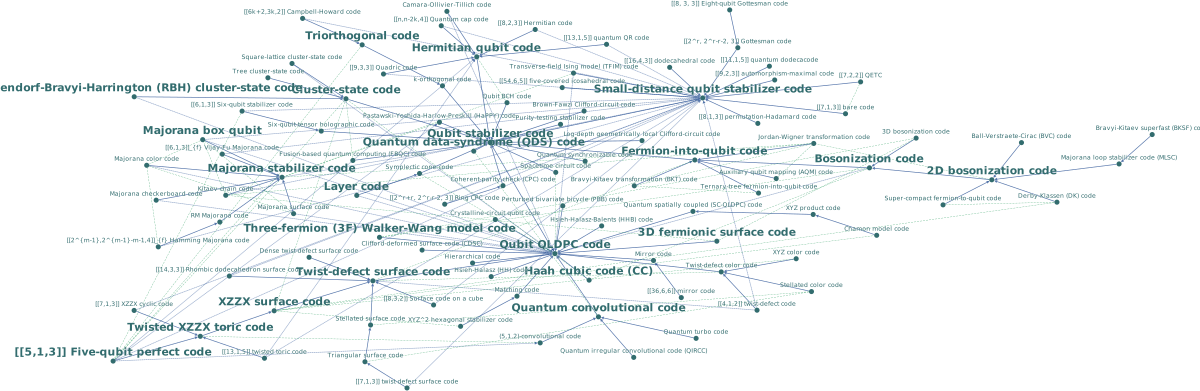
Here is a list of non-CSS qubit stabilizer codes. For non-qubit non-CSS stabilizer codes, see Stabilizer codes (non-CSS, non-qubit). For CSS codes, see Qubit CSS codes and Quantum CSS codes (non-qubit).
| Code | Description |
|---|---|
| 2D bosonization code | A mapping between a 2D lattice quadratic Hamiltonian of Majorana modes and a 2D lattice of qubits. The original exact 2D bosonization code [1] is a stabilizer code whose generators are products of plaquettes and stars of the surface code, with gauge constraints that project onto a toric-code-like subspace with emergent fermions [1,2]. Finite-depth generalized local unitary Clifford circuits generate a family of equivalent local encodings with qubit-to-fermion ratio \(r = 1 + \frac{1}{2k}\) for any positive integer \(k\); the square-lattice compact encoding with \(r=1.5\) and the super-compact encoding with \(r=1.25\) are explicit examples [2]. |
| 3D bosonization code | A mapping from a 3D lattice quadratic Hamiltonian of Majorana modes to a lattice of qubits which realizes a \(\mathbb{Z}_2\) 2-form gauge theory with a particular Gauss law. |
| 3D fermionic surface code | A non-CSS variant of the 3D Kitaev surface code that realizes \(\mathbb{Z}_2\) gauge theory with an emergent fermion, i.e., the fermionic-charge bosonic-loop (FcBl) phase [3]. The model can be defined on a cubic lattice in several ways [4; Eq. (D45-46)]. Realizations on other lattices also exist [5], and the phase of this code also exists in the 3D Kitaev honeycomb model [6]. |
| Auxiliary qubit mapping (AQM) code | A concatenation of the JW transformation code with a qubit stabilizer code. |
| Ball-Verstraete-Cirac (BVC) code | A 2D fermion-into-qubit encoding that builds upon the JW transformation by eliminating the weight-\(O(n)\) non-local \(Z\)-type string at the expense of introducing an auxiliary qubit per site and local gauge constraints. See [2; Sec. IV.B] for details. |
| Bosonization code | A mapping that maps a \(D\)-dimensional lattice quadratic Hamiltonian of Majorana modes into a lattice of qubits. The resulting qubit code can realize various topological phases, depending on the initial Majorana-mode Hamiltonian and its symmetries. |
| Bravyi-Kitaev superfast (BKSF) code | A single-error-detecting fermion-into-qubit encoding defined on a 2D qubit lattice whose stabilizers are associated with loops in the lattice. For the square-lattice edge ordering used in Ref. [2], the BKSF logical operators coincide with exact 2D bosonization on the dual lattice after relabeling \(X\) and \(Y\). The code can be generalized to a single error-correcting code (i.e., with distance three) on graphs of degree \(\geq 6\) [7]. |
| Bravyi-Kitaev transformation (BKT) code | A fermion-into-qubit encoding that maps Majorana operators into Pauli strings of weight \(\lceil \log_2(n+1) \rceil\). The code can be reformulated in terms of Fenwick trees [8], and the Pauli-string weight can be further optimized to yield the segmented Bravyi-Kitaev (SBK) transformation code [9] (see also Ref. [10]). |
| Brown-Fawzi Clifford-circuit code | An \([[n,k]]\) stabilizer code whose encoder is a random Clifford circuit of depth of order \(O(\log^3 n)\). |
| Camara-Ollivier-Tillich code | A Hermitian qubit QLDPC code whose stabilizer generator matrix is constructed using two nested subgroups of \(\mathbb{F}_4^n\). |
| Chamon model code | A foliated type-I fracton non-CSS code defined on a cubic lattice, with qubits on the even-parity sites and one weight-six stabilizer generator on each odd-parity site [12][11; Eq. (1)]. |
| Clifford-deformed surface code (CDSC) | A generally non-CSS derivative of the surface code defined by applying a translationally invariant constant-depth Clifford circuit to the original (CSS) surface code. Unlike the surface code, CDSCs include codes whose thresholds and subthreshold performance are enhanced under noise biased towards dephasing. Examples of CDSCs include the XY code, XZZX code, and random CDSCs. |
| Cluster-state code | A code based on a cluster state (a.k.a. graph state) and often used in measurement-based quantum computation (MBQC) [13,14] (a.k.a. one-way quantum processing), which substitutes the temporal dimension necessary for decoding a conventional code with a spatial dimension. This is done by encoding the computation into the features of the cluster state’s graph. |
| Coherent-parity-check (CPC) code | A qubit stabilizer code for which two binary linear codes are used to directly construct encoding and decoding circuits against \(X\)- and \(Z\)-type errors, respectively, via ZX calculus [15,16]. CPC codes can be obtained from numerical search [17]. |
| Crystalline-circuit qubit code | Code dynamically generated by constant-depth unitary Clifford circuits defined on a lattice with some crystalline symmetry. A notable example is the circuit defined on a rotated square lattice with vertices corresponding to iSWAP gates and edges decorated by \(R_X[\pi/2]\), a single-qubit rotation by \(\pi/2\) around the \(X\)-axis. This circuit is invariant under space-time translations by a unit cell \((T, a)\) and all transformations of the square lattice point group \(D_4\). |
| Dense twist-defect surface code | Member of a family of twist-defect surface codes whose twist defects are packed as densely as circuit-level error mechanisms allow, so that a rectangular patch of height \(d\) and width \(2d\) holding one domain wall encodes three logical qubits [18]. Each twist defect at an end of the domain wall is a new endpoint for logical operators, which flip between \(X\) and \(Z\) type across the wall, so that loops and mixed Pauli strings become additional independent logical operators. Merging the boundaries of an \(n_{\text{row}}\times m_{\text{col}}\) grid of such rectangles gives one patch encoding \(3 n_{\text{row}} m_{\text{col}}\) logical qubits, approaching one logical qubit per \(d(d-1)\) physical qubits, roughly twice the rate of rotated surface-code patches [18]. |
| Derby-Klassen (DK) code | A fermion-into-qubit code defined on regular tilings with maximum degree 4 whose stabilizers are associated with loops in the tiling. The code outperforms several other encodings in terms of encoding rate [19; Table I]. It has been extended for models with several modes per site [20]. |
| Fermion-into-qubit code | Qubit stabilizer code encoding a logical fermionic Hilbert space into a physical space of \(n\) qubits. Such codes are primarily intended for simulating fermionic systems on quantum computers, and some of them have error-detecting, correcting, and transmuting properties. |
| Fusion-based quantum computing (FBQC) code | Code whose codewords are resource states used in an FBQC scheme. |
| Haah cubic code (CC) | A 3D lattice stabilizer code on a length-\(L\) cubic lattice with one or two qubits per site. Admits two types of stabilizer generators with support on each cube of the lattice. In the non-CSS case, these two are related by spatial inversion. For CSS codes, we require that the product of all corner operators is the identity. We lastly require that there are no non-trivial string operators, meaning that single-site operators are a phase, and any period one logical operator \(l \in \mathsf{S}^{\perp}\) is just a phase. |
| Hermitian qubit code | A qubit stabilizer code constructed from a Hermitian self-orthogonal linear quaternary code using the Hermitian construction. |
| Hierarchical code | Member of a family of \([[n,k,d]]\) qubit stabilizer codes resulting from a concatenation of a constant-rate QLDPC code with a rotated surface code. Concatenation allows for syndrome extraction to be performed on a 2D geometry while maintaining a threshold at the expense of a logarithmically vanishing rate. The growing syndrome extraction circuit depth allows known bounds in the literature to be weakened [21,22]. |
| Hsieh-Halasz (HH) code | Member of one of two families of fracton codes, named HH-I and HH-II, defined on a cubic lattice with two qubits per site. HH-I (HH-II) is a CSS (non-CSS) stabilizer code family, with the former identified as a foliated type-I fracton code that is decomposable into two separate lattice models [4]. The sorting analysis of Ref. [4] leaves HH-II inconclusive, consistent with either a fractal type-I or a type-II fracton phase. |
| Hsieh-Halasz-Balents (HHB) code | A member of one of two fracton-code families, named HHB models A and B, defined on a cubic lattice with two qubits per site. Both are expected to be foliated type-I fracton codes [4; Eqs. (D42-D43)]. |
| Jordan-Wigner transformation code | A mapping between qubit Pauli strings and Majorana operators that can be thought of as a trivial \([[n,n]]\) code. The mapping is best described as converting a chain of \(n\) qubits into a chain of \(2n\) Majorana modes (i.e., \(n\) fermionic modes). It maps Majorana operators into Pauli strings of weight \(O(n)\). |
| Kitaev chain code | A Majorana stabilizer code obtained from the ground-state subspace of the Kitaev Majorana chain in its fermionic topological phase [23]. Its codespace is stabilized by nearest-neighbor Majorana bilinears, while two unpaired edge Majoranas furnish one logical fermionic mode. Under parity-preserving noise, it behaves as the Majorana analogue of the repetition code [24]. |
| Layer code | Member of a family of geometrically local 3D qubit QLDPC codes obtained by coupling layers of 2D surface codes according to the check-qubit incidence structure of an input QLDPC code. Geometric locality is maintained because, instead of being concatenated, each pair of parallel surface-code squares is fused (or quasi-concatenated) with perpendicular surface-code squares via lattice surgery. |
| Log-depth geometrically local Clifford-circuit code | A random \([[n,k]]\) stabilizer code whose encoder is a random Clifford circuit of depth of order \(O(\log n)\) on a 1D Euclidean geometry. |
| Majorana box qubit | A family of Majorana stabilizer codes obtained by fixing the total fermion parity of \(n\) fermionic modes, equivalently \(2n\) Majorana zero modes, within the ground-state subspace of \(n\) Kitaev Majorana chain Hamiltonians. The resulting positive-parity subspace encodes \(n-1\) logical qubits and has Majorana distance \(2\). |
| Majorana checkerboard code | A Majorana analogue of the X-cube model defined on a cubic lattice. The code admits weight-eight Majorana stabilizer generators on the eight vertices of each cube of a checkerboard sublattice. |
| Majorana color code | A fermionic analogue of a 2D color code. |
| Majorana loop stabilizer code (MLSC) | A single-error-correcting fermion-into-qubit encoding defined on a 2D qubit lattice whose stabilizers are associated with loops in the lattice. |
| Majorana stabilizer code | A stabilizer code whose stabilizers are products of an even number of Majorana fermion operators, analogous to Pauli strings for a traditional stabilizer code and referred to as Majorana stabilizers. The codespace is the mutual \(+1\) eigenspace of all Majorana stabilizers. |
| Majorana surface code | Fermionic analogue of the surface code defined on a three-colorable 2D tiling whose face operators are non-overlapping even-Majorana stabilizers. Open patches with four or six alternating colored boundaries encode logical tetrons or hexons. The uniform 4.8.8, 6.6.6, and 4.6.12 tilings yield families with tetron, hexon, or dodecon building blocks and with twist-based lattice surgery supporting minimal-overhead logical Clifford gates [25]. |
| Matching code | Member of a class of qubit stabilizer codes based on the Abelian phase of the Kitaev honeycomb model. |
| Mirror code | Stabilizer code defined by a finite group \(G\) and two subsets \(A,B\subseteq G\), with one qubit per group element [26]. Each stabilizer generator acts as \(Z\) on a translate of \(A\) and as \(X\) on a translate of \(B\), so the check weight is at most \(|A|+|B|\). Mirror codes contain all qubit Abelian 2BGA codes up to qubit permutations and Hadamard gates, and are not CSS in general. |
| Pastawski-Yoshida-Harlow-Preskill (HaPPY) code | Holographic code constructed from six-leg five-qubit perfect tensors placed on hyperbolic pentagon and hexagon tilings. The code serves as a minimal model for several aspects of the AdS/CFT holographic duality [27] and potentially a dS/CFT duality [28]. |
| Perturbed bivariate bicycle (PBB) code | Qubit stabilizer code defined over the ring \(R=\mathbb{F}_2[x,y]/(x^{\ell}-1,y^{m}-1)\) by four polynomials \(A,B,C,D\in R\) [29]. The polynomials \(C\) and \(D\) add \(Z\)-type support to the \(X\)-type checks of the BB code defined by \(A\) and \(B\). Such codes are not CSS in general. |
| Purity-testing stabilizer code | A qubit stabilizer code that is constructed from a normal rational curve and that is relevant to testing the purity of an entangled Bell state shared by two parties [30]. Purity-testing stabilizer codes have been generalized to come from more general non-projective codes [31]. |
| Quantum convolutional code | 1D translationally invariant qubit stabilizer code whose stabilizer group can be partitioned into constant-size subsets of constant support and of constant overlap between neighboring sets. Initially formulated as a quantum analogue of convolutional codes, which were designed to protect a continuous and never-ending stream of information. Precise formulations sometimes begin with a finite-dimensional lattice, with the intent to take the thermodynamic limit; logical dimension can be infinite as well. |
| Quantum data-syndrome (QDS) code | Stabilizer code designed to correct both data qubit errors and syndrome measurement errors simultaneously due to extra redundancy in its stabilizer generators. |
| Quantum irregular convolutional code (QIRCC) | Quantum convolutional code whose stabilizer group consists of different constant-size subsets. |
| Quantum spatially coupled (SC-QLDPC) code | QLDPC code whose stabilizer generator matrix resembles the parity-check matrix of SC-LDPC codes. There exist CSS [32] and stabilizer constructions [33]. In either case, the stabilizer generator matrix is constructed by “spatially” coupling sub-matrix blocks in chain-like fashion (or, more generally, in grid-like fashion) to yield a band matrix. The sub-matrix blocks have to satisfy certain conditions amongst themselves so that the resulting band matrix is a stabilizer generator matrix. Matrices corresponding to translationally invariant chains are called time-invariant, and otherwise are called time-varying. |
| Quantum synchronizable code | A qubit stabilizer code designed to protect against synchronization errors (a.k.a. misalignment), which are errors that misalign the code block in a larger block by one or more locations. |
| Quantum turbo code | A quantum version of the turbo code, obtained from an interleaved serial quantum concatenation [34; Def. 30] of quantum convolutional codes. The interleaver induces long-range entanglement and can increase the minimum distance relative to the constituent convolutional codes [35]. |
| Qubit BCH code | Qubit stabilizer code constructed from a self-orthogonal binary BCH code via the CSS construction, from a Hermitian self-orthogonal quaternary BCH code via the Hermitian construction, or by taking a Euclidean self-orthogonal BCH code over \(\mathbb{F}_{2^m}\), converting it to a binary code, and applying the CSS construction. |
| Qubit QLDPC code | Member of a family of \([[n,k,d]]\) qubit stabilizer codes for which the number of sites participating in each stabilizer generator and the number of stabilizer generators that each site participates in are both bounded by a constant \(w\) as \(n\to\infty\). The code can be denoted by \([[n,k,d,w]]\). Sometimes, the two parameters are explicitly stated: each site of an \((l,w)\)-regular qubit QLDPC code is acted on by \(\leq l\) generators of weight \(\leq w\). |
| Qubit stabilizer code | An \(((n,2^k,d))\) qubit stabilizer code is denoted as \([[n,k]]\) or \([[n,k,d]]\), where \(k\) is the number of logical qubits (code dimension), and where \(d\) is the code’s distance. The logical subspace is the joint eigenspace of commuting Pauli operators forming the code’s stabilizer group \(\mathsf{S}\). Traditionally, the logical subspace is the joint \(+1\) eigenspace of a set of \(2^{n-k}\) commuting Pauli operators which do not contain \(-I\). The distance is the minimum weight of a Pauli string that implements a nontrivial logical operation in the code. |
| RM Majorana code | A Majorana stabilizer code constructed from a self-orthogonal RM code. These codes have the additional property that the global fermion parity is fixed in the codespace. Logical measurements are reduced to parity measurements of some subset of Majorana fermions in the code. |
| Raussendorf-Bravyi-Harrington (RBH) cluster-state code | A three-dimensional cluster-state code defined on the bcc lattice (i.e., a cubic lattice with qubits on edges and faces). |
| Six-qubit-tensor holographic code | Holographic tensor-network code constructed out of a network of encoding isometries of the \([[6,1,3]]\) six-qubit stabilizer code. The structure of the isometry is similar to that of the heptagon holographic code since both isometries are rank-six tensors, but the isometry in this case is neither a perfect tensor nor a planar-perfect tensor. |
| Small-distance qubit stabilizer code | A qubit stabilizer code that either detects or corrects errors on at most two subsystems, i.e., has distance \(\leq 5\). |
| Spacetime circuit code | Qubit stabilizer code constructed from a Clifford circuit, i.e., a circuit made up of Clifford gates and Pauli measurements, in order to detect and correct circuit faults. The code utilizes redundancy in the measurement outcomes of a circuit to correct circuit faults, which correspond to Pauli errors of the code. |
| Square-lattice cluster-state code | A code based on the cluster state on a square lattice that was used in the first proposal for MBQC [13,14]. In the one-way model, the pre-entangled square-lattice cluster is a universal resource, and the computation is carried out entirely by adaptive single-qubit measurements. |
| Stellated color code | A non-CSS color-code family on a lattice patch with a single central puncture that hosts a twist defect connected to the boundary by a domain wall. |
| Stellated surface code | A twist-defect surface-code family parameterized by a rotational symmetry order \(s\), with a central toric-code twist connected to the boundary by a domain wall. The \(s=3\) member is the triangular surface code [36]. |
| Super-compact fermion-to-qubit code | A 2D fermion-into-qubit encoding on the square lattice obtained from exact 2D bosonization by a finite-depth generalized local unitary Clifford circuit, followed by re-pairing of Majorana modes and a slight lattice deformation. The code uses \(1.25\) qubits per fermion, improving on the square-lattice compact encoding with ratio \(r=1.5\). Its fermion-parity, hopping, and stabilizer operators have weights \(1\)-\(2\), \(2\)-\(6\), and \(12\), respectively [2; Table I]. |
| Symplectic cone code | Qubit stabilizer code obtained by attaching a CSS ancilla code to an input stabilizer code represented as a symplectic complex, with the output logical operators determined by an embedded column complex [37]. Gluing maps extend the ancilla \(X\)-type checks onto the input qubits and the input checks onto the ancilla qubits. A defect map then adds \(Z\)-type support on the ancilla’s own qubits to the ancilla \(X\)-type checks so that all extended checks commute. The construction generalizes the mapping cone framework of quantum code embedding from CSS codes to arbitrary stabilizer codes [37]. |
| Ternary-tree fermion-into-qubit code | A fermion-into-qubit encoding defined on ternary trees that maps Majorana operators into Pauli strings of weight \(\lceil \log_3 (2n+1) \rceil\). |
| Three-fermion (3F) Walker-Wang model code | A 3D lattice stabilizer code whose bulk realizes a 3D time-reversal SPT order [38] and whose gapped boundary supports the 2D three-fermion (3F) topological order. The code can be used as a resource state for fault-tolerant MBQC [39]. |
| Transverse-field Ising model (TFIM) code | A 1D translationally invariant stabilizer code whose encoding is a constant-depth circuit of nearest-neighbor gates on alternating even and odd bonds that consist of transverse-field Ising Hamiltonian interactions. The code allows for perfect state transfer of arbitrary distance using local operations and classical communications (LOCC). |
| Tree cluster-state code | Code obtained from a cluster state on a tree graph (e.g., a star graph [40,41]) that has been proposed in the context of quantum repeater and MBQC architectures. |
| Triangular surface code | A member of a twist-defect surface code family with a single central twist whose planar layout fits within a triangle. Triangle codes can be viewed as three conjoined surface-code patches projected into two dimensions, with weight-four plaquette stabilizers and weight-two edge stabilizers [36]. Symmetric distance-\(d\) triangle codes use \(3d^2/4+1/4\) data qubits, i.e., about \(25\%\) fewer than the rotated surface code for a given odd distance. Logical \(\overline{X}\), \(\overline{Y}\), and \(\overline{Z}\) operators can be supported on the three sides of the triangle, enabling initialization and measurement in any Pauli basis. |
| Triorthogonal code | Qubit CSS codes realize logical diagonal non-Clifford gates through transversal \(T\) gates followed by diagonal Clifford corrections. |
| Twist-defect color code | A non-CSS extension of the 2D color code whose non-CSS stabilizer generators are associated with twist defects of the associated lattice. These twists terminate domain walls that permute color labels, Pauli labels, or interchange the two. |
| Twist-defect surface code | A non-CSS extension of the 2D surface-code construction whose non-CSS stabilizer generators are associated with twist defects of the associated lattice. A related construction [42] doubles the number of qubits in the lattice via symplectic doubling. |
| Twisted XZZX toric code | A cyclic code that can be thought of as the XZZX toric code with shifted (a.k.a twisted) boundary conditions. Admits a set of stabilizer generators that are equivalent to cyclic shifts of a particular weight-four \(XZZX\) Pauli string. |
| XYZ color code | A variant of the 6.6.6 color code whose generators are \(XZXZXZ\) and \(ZYZYZY\) Pauli strings associated to each hexagonal in the hexagonal (6.6.6) tiling. A further variation called the domain wall color code admits generators of the form \(XXXZZZ\) and \(ZZZXXX\) [43]. While such codes are equivalent to CSS color codes with the same distance, other properties like noise-bias performance can differ significantly. |
| XYZ product code | A non-CSS QLDPC code obtained from a three-fold variant of the hypergraph product applied to three classical binary codes with parity-check matrices \(H_1,H_2,H_3\). The parity-check matrices \(H_1\), \(H_2\), and \(H_3\) set the Pauli-\(X\), \(Y\), and \(Z\) components of the stabilizer generators, respectively [44; Sec. 3.1]. Under mild assumptions, the code dimension is determined by a tensor Sylvester equation over \(\mathbb{F}_2\), and the minimum-distance problem reduces up to constant factors to how closely a related inhomogeneous tensor Sylvester equation can be satisfied [44]. When the underlying classical codes are repetition codes, the construction yields the Chamon model code. |
| XYZ\(^2\) hexagonal stabilizer code | An instance of the matching code based on the Kitaev honeycomb model. It is described on a honeycomb tiling with \(XYZXYZ\) stabilizers on each hexagonal plaquette. Each vertical pair of qubits has an \(XX\), \(YY\), or \(ZZ\) link stabilizer depending on the orientation of the plaquette stabilizers. |
| XZZX surface code | A variant of the rotated surface code whose generators are \(XZZX\) Pauli strings associated, clockwise, to the vertices of each face of a two-dimensional lattice (with a qubit located at each vertex of the tessellation). |
| \((5,1,2)\)-convolutional code | Family of quantum convolutional codes that are 1D lattice generalizations of the five-qubit perfect code, with the former’s lattice-translation symmetry being the extension of the latter’s cyclic permutation symmetry. |
| \([[11,1,5]]\) quantum dodecacode | Eleven-qubit pure stabilizer code that is the smallest qubit stabilizer code to correct two-qubit errors. It can be obtained from the additive but not \(\mathbb{F}_4\)-linear dodecacode by puncturing [45; Table IV]. |
| \([[13,1,5]]\) quantum QR code | Thirteen-qubit cyclic Hermitian qubit code derived from a quaternary quadratic-residue code using the Hermitian construction [47][46; pg. 11]. The code admits a stabilizer tableau whose rows are cyclic permutations of the Pauli string \(XXZZIZIIIZIZZ\) [48; ID 67067199e766ad364e845262]. |
| \([[13,1,5]]\) twisted toric code | Thirteen-qubit twisted toric code whose stabilizer tableau consists of cyclic permutations of the \(XZZX\)-type Pauli string \(XIZZIXIIIIIII\). The code can be thought of as a small twisted XZZX code [49; Exam. 11 and Fig. 3]. |
| \([[14,3,3]]\) Rhombic dodecahedron surface code | A \([[14,3,3]]\) twist-defect surface code whose qubits lie on the vertices of a rhombic dodecahedron. Its non-CSS nature is due to twist defects [50] stemming from the geometry of the polytope. A local-Clifford-equivalent clean realization has only \(X\)- and \(Z\)-type operators on its four-valent vertices, and its symplectic double is a \([[28,6,3]]\) genus-three code [42]. |
| \([[16,4,3]]\) dodecahedral code | A \([[16,4,3]]\) non-CSS qubit stabilizer code whose encoder-respecting form is the graph of vertices of a dodecahedron [51]. |
| \([[2^r+r, 2^r-r-2, 3]]\) Ring CPC code | A family of \([[2^r+r, 2^r-r-2, 3]]\) CPC codes for \(r \geq 3\) whose matrices are based on the shortened version of the \([2^r-1,2^r-r-1,3]\) Hamming code. See [52; Thm. 4] for their stabilizer generator matrix. |
| \([[2^r, 2^r-r-2, 3]]\) Gottesman code | A family of pure [45] non-CSS stabilizer codes of distance \(3\) that saturate the asymptotic quantum Hamming bound. |
| \([[2^{m-1},2^{m-1}-m-1,4]]_{f}\) Hamming Majorana code | A member of the \([[2^{m-1},2^{m-1}-m-1,4]]_{f}\) family of Majorana stabilizer codes for \(m \geq 3\) constructed from a self-orthogonal first-order RM code (whose dual is the extended Hamming code). A shortened \([[2^{m-1}-1,2^{m-1}-m-2,3]]_{f}\) version can also be defined [53; Prop. 2.5.1]. The logical subspace of the \([[8,3,4]]_{f}\) Hamming Majorana code is a Cartan subspace of the \(E_8\) Lie algebra [54]. |
| \([[36,6,6]]\) mirror code | Abelian mirror code on \(G=\mathbb{Z}_6\times\mathbb{Z}_6\) with check weight six that is not equivalent to a CSS code via Hadamard gates [26; Fig. 1]. Its symplectic double is the half-gross code. |
| \([[4,1,2]]\) twist-defect code | A four-qubit non-CSS stabilizer code that can be interpreted as the smallest triangular color code with \(x\)-, \(y\)-, and \(z\)-type Pauli boundaries [55; Fig. 7], and equivalently as a small twist-defect surface code on a tetrahedron inscribed in a sphere [42]. It is the only non-CSS qubit stabilizer code with parameters \([[4,1,2]]\). The code admits weight-three stabilizer generators and weight-two logical Pauli \(X,Y,Z\) operators. |
| \([[5,1,3]]\) Five-qubit perfect code | Five-qubit cyclic stabilizer code that is the smallest qubit stabilizer code to correct a single-qubit error. |
| \([[54,6,5]]\) five-covered icosahedral code | A \([[54,6,5]]\) qubit stabilizer code whose encoder-respecting form is the graph of a five-cover of the icosahedron [51]. The covering-space construction avoids the weight-three logical operators that occur for the bare icosahedral graph [51]. |
| \([[6,1,3]]\) Six-qubit stabilizer code | A degenerate, non-trivial \([[6,1,3]]\) stabilizer code. It is one of two six-qubit distance-three codes that are unique up to equivalence [45], with the other code being decomposable and an extension of the five-qubit code [56][57; ID 87]. The code admits fault-tolerant syndrome extraction using only one ancilla per stabilizer generator measurement. |
| \([[6,1,3]]_{f}\) Vijay-Fu Majorana code | A Majorana stabilizer code encoding a logical fermion into six physical fermions. This code is the shortest code correcting single fermion-parity flips [58]. |
| \([[6k+2,3k,2]]\) Campbell-Howard code | Family of \([[6k+2,3k,2]]\) qubit stabilizer codes with quasi-transversal \(CCZ^{\otimes k}\) gates that are relevant to magic-state distillation. In the synthillation framework, these distance-two codes realize batches of logical \(CCZ\) gates using physical \(T\) gates followed by a Clifford correction. |
| \([[7,1,3]]\) XZZX cyclic code | A \([[7,1,3]]\) cyclic non-CSS code whose stabilizer generators are the seven cyclic shifts of the weight-four Pauli string \(XZIZXII\), any six of which are independent. The non-identity support of this generator is \(XZZX\) (at positions 0, 1, 3, 4), making this a member of the twisted XZZX code family. It is one of sixteen distinct indecomposable \([[7,1,3]]\) codes [59]. |
| \([[7,1,3]]\) bare code | A \([[7,1,3]]\) code that admits fault-tolerant syndrome extraction using only one ancilla per stabilizer generator measurement. |
| \([[7,1,3]]\) twist-defect surface code | A \([[7,1,3]]\) code (different from the Steane code) that is a small example of a twist-defect surface code. |
| \([[7,2,2]]\) QETC | Seven-qubit pure QETC that transmutes all single-qubit Pauli errors to logical phase errors. |
| \([[8, 3, 3]]\) Eight-qubit Gottesman code | Eight-qubit pure code that can be obtained from a modified CSS construction using the \([8,4,4]\) extended Hamming code and a \([8,7,2]\) even-weight code [60]. The modification introduces signs between the codewords. |
| \([[8,1,3]]\) permutation-Hadamard code | A non-CSS cyclic stabilizer code that is the shortest code to realize a logical Hadamard gate via a single cyclic relabelling of the physical qubits. |
| \([[8,2,3]]\) Hermitian code | A non-CSS Hermitian eight-qubit stabilizer code that is the only Hermitian code and that has the largest automorphism group among the 20 inequivalent \([[8,2,3]]\) codes [61]. The code has an exceptionally short fault-tolerant syndrome measurement sequence [61,62]. |
| \([[8,3,2]]\) Surface code on a cube | An \([[8,3,2]]\) twist-defect surface code whose qubits lie on the vertices of a cube. It is obtained by three-coloring the faces of a cube and placing \(X\), \(Y\), and \(Z\) stabilizer generators on each pair of faces of the same color. Its non-CSS nature is due to twist defects [50] stemming from the geometry of the polytope. |
| \([[9,2,3]]\) automorphism-maximal code | A non-CSS stabilizer code on which single-qubit Clifford gates together with qubit permutations realize the largest logical group attainable on two logical qubits. It is the smallest distance-three stabilizer code with this property. |
| \([[9,3,3]]\) Quadric code | Nine-qubit pure Hermitian qubit code constructed from the almost MDS \([9,3,6]_4\) Hermitian self-orthogonal code. It is the only pure Hermitian code with its parameters and is the highest-distance qubit stabilizer code for its \(n\) and \(k\). |
| \([[n,n-2k,4]]\) Quantum cap code | A distance-four pure Hermitian qubit code constructed from a Hermitian self-orthogonal \([n,k]_4\) code associated with an \(n\)-cap in \(PG(k-1,4)\). |
| \(k\)-orthogonal code | Qubit stabilizer code for which the binary space \(S_X\) of \(X\) components of stabilizers is \(k\)-orthogonal in the symplectic representation. In other words, the overlap of any \(j\) vectors in \(S_X\) is even for every \(1\leq j\leq k\) [63; Def. 4]. This definition applies to general qubit stabilizer codes and does not require a CSS presentation. The notion extends to modular qudits [64]. |
List: Codes that are descendants of Qubit stabilizer code and not descendants of Qubit CSS code.
References
- [1]
- Y.-A. Chen, A. Kapustin, and Đ. Radičević, “Exact bosonization in two spatial dimensions and a new class of lattice gauge theories”, Annals of Physics 393, 234 (2018) arXiv:1711.00515 DOI
- [2]
- Y.-A. Chen and Y. Xu, “Equivalence between Fermion-to-Qubit Mappings in two Spatial Dimensions”, PRX Quantum 4, (2023) arXiv:2201.05153 DOI
- [3]
- L. Fidkowski, J. Haah, and M. B. Hastings, “Gravitational anomaly of (3+1) -dimensional Z2 toric code with fermionic charges and fermionic loop self-statistics”, Physical Review B 106, (2022) arXiv:2110.14654 DOI
- [4]
- A. Dua, I. H. Kim, M. Cheng, and D. J. Williamson, “Sorting topological stabilizer models in three dimensions”, Physical Review B 100, (2019) arXiv:1908.08049 DOI
- [5]
- S. Ryu, “Three-dimensional topological phase on the diamond lattice”, Physical Review B 79, (2009) arXiv:0811.2036 DOI
- [6]
- S. Mandal and N. Surendran, “Exactly solvable Kitaev model in three dimensions”, Physical Review B 79, (2009) arXiv:0801.0229 DOI
- [7]
- K. Setia, S. Bravyi, A. Mezzacapo, and J. D. Whitfield, “Superfast encodings for fermionic quantum simulation”, Physical Review Research 1, (2019) arXiv:1810.05274 DOI
- [8]
- P. M. Fenwick, “A new data structure for cumulative frequency tables”, Software: Practice and Experience 24, 327 (1994) DOI
- [9]
- V. Havlíček, M. Troyer, and J. D. Whitfield, “Operator locality in the quantum simulation of fermionic models”, Physical Review A 95, (2017) arXiv:1701.07072 DOI
- [10]
- A. Y. Vlasov, “Clifford Algebras, Spin Groups and Qubit Trees”, Quanta 11, 97 (2022) arXiv:1904.09912 DOI
- [11]
- S. Bravyi, B. Leemhuis, and B. M. Terhal, “Topological order in an exactly solvable 3D spin model”, Annals of Physics 326, 839 (2011) arXiv:1006.4871 DOI
- [12]
- W. Shirley, X. Liu, and A. Dua, “Emergent fermionic gauge theory and foliated fracton order in the Chamon model”, Physical Review B 107, (2023) arXiv:2206.12791 DOI
- [13]
- R. Raussendorf, D. Browne, and H. Briegel, “The one-way quantum computer–a non-network model of quantum computation”, Journal of Modern Optics 49, 1299 (2002) arXiv:quant-ph/0108118 DOI
- [14]
- R. Raussendorf and H. J. Briegel, “A One-Way Quantum Computer”, Physical Review Letters 86, 5188 (2001) DOI
- [15]
- B. Coecke and R. Duncan, “Interacting Quantum Observables”, Lecture Notes in Computer Science 298 DOI
- [16]
- B. Coecke and R. Duncan, “Interacting quantum observables: categorical algebra and diagrammatics”, New Journal of Physics 13, 043016 (2011) arXiv:0906.4725 DOI
- [17]
- J. Roffe, D. Headley, N. Chancellor, D. Horsman, and V. Kendon, “Protecting quantum memories using coherent parity check codes”, Quantum Science and Technology 3, 035010 (2018) arXiv:1709.01866 DOI
- [18]
- G. H. Low, W. J. Huggins, D. W. Berry, T. Khattar, A. F. White, N. C. Rubin, and R. Babbush, “A Denser Planar Surface Code”, (2026) arXiv:2605.30455
- [19]
- C. Derby, J. Klassen, J. Bausch, and T. Cubitt, “Compact fermion to qubit mappings”, Physical Review B 104, (2021) arXiv:2003.06939 DOI
- [20]
- L. Clinton, T. Cubitt, B. Flynn, F. M. Gambetta, J. Klassen, A. Montanaro, S. Piddock, R. A. Santos, and E. Sheridan, “Towards near-term quantum simulation of materials”, Nature Communications 15, (2024) arXiv:2205.15256 DOI
- [21]
- N. Delfosse, M. E. Beverland, and M. A. Tremblay, “Bounds on stabilizer measurement circuits and obstructions to local implementations of quantum LDPC codes”, (2021) arXiv:2109.14599
- [22]
- N. Baspin, O. Fawzi, and A. Shayeghi, “A lower bound on the overhead of quantum error correction in low dimensions”, (2023) arXiv:2302.04317
- [23]
- A. Y. Kitaev, “Unpaired Majorana fermions in quantum wires”, Physics-Uspekhi 44, 131 (2001) arXiv:cond-mat/0010440 DOI
- [24]
- A. Schuckert, E. Crane, A. V. Gorshkov, M. Hafezi, and M. J. Gullans, “Fault-tolerant fermionic quantum computing”, (2025) arXiv:2411.08955
- [25]
- D. Litinski and F. von Oppen, “Quantum computing with Majorana fermion codes”, Physical Review B 97, (2018) arXiv:1801.08143 DOI
- [26]
- A. B. Khesin and J. Z. Lu, “Mirror codes: High-threshold quantum LDPC codes beyond the CSS regime”, (2026) arXiv:2603.05496
- [27]
- T. J. Osborne and D. E. Stiegemann, “Dynamics for holographic codes”, Journal of High Energy Physics 2020, (2020) arXiv:1706.08823 DOI
- [28]
- J. Cotler and A. Strominger, “The Universe as a Quantum Encoder”, (2022) arXiv:2201.11658
- [29]
- J. Cruz-Benito, A. W. Cross, D. Kremer, and I. Faro, “Evolutionary Discovery of Bivariate Bicycle Codes with LLM-Guided Search”, (2026) arXiv:2606.02418
- [30]
- H. Barnum, C. Crepeau, D. Gottesman, A. Smith, and A. Tapp, “Authentication of quantum messages”, The 43rd Annual IEEE Symposium on Foundations of Computer Science, 2002. Proceedings. 449 arXiv:quant-ph/0205128 DOI
- [31]
- R. Trényi, S. Ball, D. G. Glynn, and M. Curty, “Geometrical Constructions of Purity Testing Protocols and Their Applications to Quantum Communication”, IEEE Transactions on Information Theory 72, 4041 (2026) arXiv:2503.14003 DOI
- [32]
- M. Hagiwara, K. Kasai, H. Imai, and K. Sakaniwa, “Spatially Coupled Quasi-Cyclic Quantum LDPC Codes”, (2011) arXiv:1102.3181
- [33]
- S. Yang and R. Calderbank, “Spatially-Coupled QLDPC Codes”, Quantum 9, 1693 (2025) arXiv:2305.00137 DOI
- [34]
- D. Poulin, J.-P. Tillich, and H. Ollivier, “Quantum serial turbo-codes”, (2009) arXiv:0712.2888
- [35]
- A. J. Ferris and D. Poulin, “Tensor Networks and Quantum Error Correction”, Physical Review Letters 113, (2014) arXiv:1312.4578 DOI
- [36]
- T. J. Yoder and I. H. Kim, “The surface code with a twist”, Quantum 1, 2 (2017) arXiv:1612.04795 DOI
- [37]
- A. C. Yuan and N. Baspin, “Non-CSS Quantum Code Embedding”, (2026) arXiv:2608.16995
- [38]
- F. J. Burnell, X. Chen, L. Fidkowski, and A. Vishwanath, “Exactly soluble model of a three-dimensional symmetry-protected topological phase of bosons with surface topological order”, Physical Review B 90, (2014) arXiv:1302.7072 DOI
- [39]
- S. Roberts and D. J. Williamson, “3-Fermion Topological Quantum Computation”, PRX Quantum 5, (2024) arXiv:2011.04693 DOI
- [40]
- K. Fujii and K. Yamamoto, “Topological one-way quantum computation on verified logical cluster states”, Physical Review A 82, (2010) arXiv:1008.2048 DOI
- [41]
- K. Fujii and Y. Tokunaga, “Fault-Tolerant Topological One-Way Quantum Computation with Probabilistic Two-Qubit Gates”, Physical Review Letters 105, (2010) arXiv:1008.3752 DOI
- [42]
- S. Burton, E. Durso-Sabina, and N. C. Brown, “Genons, Double Covers and Fault-tolerant Clifford Gates”, (2024) arXiv:2406.09951
- [43]
- K. Tiurev, A. Pesah, P.-J. H. S. Derks, J. Roffe, J. Eisert, M. S. Kesselring, and J.-M. Reiner, “Domain Wall Color Code”, Physical Review Letters 133, (2024) arXiv:2307.00054 DOI
- [44]
- A. Leverrier, S. Apers, and C. Vuillot, “Quantum XYZ Product Codes”, Quantum 6, 766 (2022) arXiv:2011.09746 DOI
- [45]
- A. R. Calderbank, E. M. Rains, P. W. Shor, and N. J. A. Sloane, “Quantum Error Correction via Codes over GF(4)”, (1997) arXiv:quant-ph/9608006
- [46]
- F. Vatan, V. P. Roychowdhury, and M. P. Anantram, “Spatially Correlated Qubit Errors and Burst-Correcting Quantum Codes”, (1997) arXiv:quant-ph/9704019
- [47]
- R. Dastbasteh and P. Lisonek, “New quantum codes from self-dual codes over F_4”, (2022) arXiv:2211.00891
- [48]
- S. Burton, “qecdb.org: Quantum Error Correction Database”, URL
- [49]
- A. A. Kovalev, I. Dumer, and L. P. Pryadko, “Design of additive quantum codes via the code-word-stabilized framework”, Physical Review A 84, (2011) arXiv:1108.5490 DOI
- [50]
- H. Bombin, “Topological Order with a Twist: Ising Anyons from an Abelian Model”, Physical Review Letters 105, (2010) arXiv:1004.1838 DOI
- [51]
- A. B. Khesin, J. Z. Lu, and P. W. Shor, “Universal Graph Representation of Stabilizer Codes”, PRX Quantum 6, (2025) arXiv:2411.14448 DOI
- [52]
- N. Chancellor, A. Kissinger, S. Zohren, J. Roffe, and D. Horsman, “Graphical structures for design and verification of quantum error correction”, Quantum Science and Technology 8, 045028 (2023) arXiv:1611.08012 DOI
- [53]
- R. Okada, “A Quantum Analog of Delsarte’s Linear Programming Bounds”, (2025) arXiv:2502.14165
- [54]
- P. Lévay and F. Holweck, “A fermionic code related to the exceptional group E \({}_{\text{8}}\)”, Journal of Physics A: Mathematical and Theoretical 51, 325301 (2018) arXiv:1801.06998 DOI
- [55]
- M. S. Kesselring, F. Pastawski, J. Eisert, and B. J. Brown, “The boundaries and twist defects of the color code and their applications to topological quantum computation”, Quantum 2, 101 (2018) arXiv:1806.02820 DOI
- [56]
- B. Shaw, M. M. Wilde, O. Oreshkov, I. Kremsky, and D. A. Lidar, “Encoding one logical qubit into six physical qubits”, Physical Review A 78, (2008) arXiv:0803.1495 DOI
- [57]
- Qiskit Community, “Qiskit QEC framework”, URL
- [58]
- S. Vijay and L. Fu, “Quantum Error Correction for Complex and Majorana Fermion Qubits”, (2017) arXiv:1703.00459
- [59]
- S. Yu, Q. Chen, and C. H. Oh, “Graphical Quantum Error-Correcting Codes”, (2007) arXiv:0709.1780
- [60]
- A. M. Steane, “Simple quantum error-correcting codes”, Physical Review A 54, 4741 (1996) arXiv:quant-ph/9605021 DOI
- [61]
- A. Cross and D. Vandeth, “Small Binary Stabilizer Subsystem Codes”, (2025) arXiv:2501.17447
- [62]
- N. Delfosse and B. W. Reichardt, “Short Shor-style syndrome sequences”, (2020) arXiv:2008.05051
- [63]
- S. Koutsioumpas, D. Banfield, and A. Kay, “The Smallest Code with Transversal T”, (2022) arXiv:2210.14066
- [64]
- F. H. E. Watson, E. T. Campbell, H. Anwar, and D. E. Browne, “Qudit color codes and gauge color codes in all spatial dimensions”, Physical Review A 92, (2015) arXiv:1503.08800 DOI