Here is a list of codes related to qubit stabilizer codes that detect or correct an error on at most two qubits.
| Code | Description |
|---|---|
| Ball code | A distance-two color code defined on a colorable \(D\)-ball, equivalently on a \(D\)-colex with boundary [1; Appx. A]. In the morphing construction of Ref. [1], ball codes arise as the child codes associated with the morphed ball-like regions. This family includes hypercube codes (defined on balls constructed from hyperoctahedra) and 3D ball codes (defined on duals of certain Archimedean solids). |
| Hyperbolic color code | An extension of the color code construction to hyperbolic manifolds. As opposed to there being only three types of uniform three-valent and three-colorable lattice tilings in the 2D Euclidean plane, there is an infinite number of admissible hyperbolic tilings in the 2D hyperbolic plane [2]. Certain double covers of hyperbolic tilings also yield admissible tilings [3]. Other admissible hyperbolic tilings can be obtained via a fattening procedure [4]; see also a construction based on the more general quantum pin codes [5]. |
| Kitaev chain code | A Majorana stabilizer code obtained from the ground-state subspace of the Kitaev Majorana chain in its fermionic topological phase [6]. Its codespace is stabilized by nearest-neighbor Majorana bilinears, while two unpaired edge Majoranas furnish one logical fermionic mode. Under parity-preserving noise, it behaves as the Majorana analogue of the repetition code [7]. |
| Majorana box qubit | A family of Majorana stabilizer codes obtained by fixing the total fermion parity of \(n\) fermionic modes, equivalently \(2n\) Majorana zero modes, within the ground-state subspace of \(n\) Kitaev Majorana chain Hamiltonians. The resulting positive-parity subspace encodes \(n-1\) logical qubits and has Majorana distance \(2\). |
| Quantum multi-dimensional parity-check (QMDPC) code | High-rate low-distance CSS code whose qubits lie on a \(D\)-dimensional rectangle, with \(X\)-type stabilizer generators defined on each \(D-1\)-dimensional rectangle. The \(Z\)-type stabilizer generators are defined via permutations in order to commute with the \(X\)-type generators. |
| Quantum repetition code | Encodes \(1\) qubit into \(n\) qubits according to \(|0\rangle\to|\phi_0\rangle^{\otimes n}\) and \(|1\rangle\to|\phi_1\rangle^{\otimes n}\). The code is called a bit-flip code when \(|\phi_i\rangle = |i\rangle\), and a phase-flip code when \(|\phi_0\rangle = |+\rangle\) and \(|\phi_1\rangle = |-\rangle\). This repetition-style encoding does not clone an arbitrary quantum state; instead, it extends the copying of computational-basis states linearly to entangled codewords [8; Ch. 2]. |
| Reinforcement-learning quantum code | An approximate qubit code obtained from a numerical optimization involving a reinforcement learning agent. |
| Small-distance qubit stabilizer code | A qubit stabilizer code that either detects or corrects errors on at most two subsystems, i.e., has distance \(\leq 5\). |
| Tetron code | A \([[2,1,2]]_{f}\) Majorana box qubit encoding a logical qubit into four Majorana modes, equivalently into the fixed-total-parity sector of two physical fermionic modes. Four Majorana zero modes are the smallest aggregate that supports a qubit in a fixed fermion-parity sector [9]. This code can be concatenated with various qubit codes such as surface codes and color codes. Four-boundary Majorana surface-code patches are logical tetrons, i.e., higher-distance analogues of this physical tetron block [10]. |
| Transverse-field Ising model (TFIM) code | A 1D translationally invariant stabilizer code whose encoding is a constant-depth circuit of nearest-neighbor gates on alternating even and odd bonds that consist of transverse-field Ising Hamiltonian interactions. The code allows for perfect state transfer of arbitrary distance using local operations and classical communications (LOCC). |
| Trapezoid subsystem code | A member of a family of BBS codes with weight-two (two-body) gauge generators designed to suppress errors in adiabatic quantum computation. |
| \([[10,1,2]]\) Vasmer-Kubica code | A stabilizer code obtained by morphing the \([[15,1,3]]\) quantum Reed-Muller code on a subset whose child code is the \([[8,3,2]]\) smallest interesting color code [1]. It is the smallest known stabilizer code with a fault-tolerant logical \(T\) gate, implemented via physical \(T\), \(T^{\dagger}\), and \(CCZ\) gates [1]. |
| \([[10,1,3;1,3,4]]\) EAOA Hamming code | An EAOA qubit stabilizer code constructed from the dual of a \([10,6,3]\) code obtained by shortening the classical \([15,11,3]\) Hamming code at five positions. In the notation of the parent entry, the example of Ref. [11] is a \([[10,1,3;1,3,4]]\) code: it encodes one logical qubit and four classical strings (equivalently, two classical bits), while retaining one gauge qubit and using three ebits. |
| \([[10,2,3]]\) binarized Galois-qudit code | CSS code obtained by binarizing a \([[5,1,3]]_4\) Galois-qudit CSS code in the self-dual normal basis \(\{\omega,\omega^2\}\). Since that Galois-qudit code is a symplectic double of the \([[5,1,3]]\) five-qubit perfect code, this code is a symplectic double of the five-qubit code as well [12]. |
| \([[10,2,3]]\) rotated toric code | Rotated toric code that is the CSS form of the twisted XZZX toric code with parameters \(a=1\), \(b=3\) [13,14], related to the XZZX form by Hadamard on the \(B\)-sublattice. It is also a symplectic double (a.k.a. genus-one double cover) of the \([[5,1,3]]\) five-qubit perfect code [15,16], the symplectic double of the \([[5,1,2]]\) rotated surface code [16], and a BCC code [17]. |
| \([[11,1,5]]\) quantum dodecacode | Eleven-qubit pure stabilizer code that is the smallest qubit stabilizer code to correct two-qubit errors. It can be obtained from the additive but not \(\mathbb{F}_4\)-linear dodecacode by puncturing [18; Table IV]. |
| \([[12,1,3]]\) CE CSS code | Twelve-qubit constant-excitation (CE) CSS code that encodes one logical qubit with distance three. It is the smallest distance-three CE CSS code obtainable by dual-rail concatenation [19]. Codewords lie in a fixed Hamming-weight subspace, making the code immune to coherent noise in the form of transversal \(Z\)-rotations. |
| \([[12,2,2]]\) CSS code | CSS code that admits a logical \(CS\) gate via application of physical \(T\) and \(T^{\dagger}\) gates. |
| \([[12,2,4]]\) carbon code | Twelve-qubit CSS code based on Knill’s \(C_4/C_6\) scheme [20]. Using the concatenation convention of the Zoo, the carbon code can be viewed as a block concatenation with inner code \([[6,2,2]]\) and outer code \([[4,2,2]]\): the inner \([[6,2,2]]\) code encodes two logical qubits into six intermediate qubits, each pair of which is then encoded into an outer \([[4,2,2]]\) block. |
| \([[13,1,5]]\) quantum QR code | Thirteen-qubit cyclic Hermitian qubit code derived from a quaternary quadratic-residue code using the Hermitian construction [22][21; pg. 11]. The code admits a stabilizer tableau whose rows are cyclic permutations of the Pauli string \(XXZZIZIIIZIZZ\) [23; ID 67067199e766ad364e845262]. |
| \([[13,1,5]]\) twisted toric code | Thirteen-qubit twisted toric code whose stabilizer tableau consists of cyclic permutations of the \(XZZX\)-type Pauli string \(XIZZIXIIIIIII\). The code can be thought of as a small twisted XZZX code [13; Exam. 11 and Fig. 3]. |
| \([[14,3,3]]\) CE phantom code | CSS phantom code obtained by concatenating the \([[7,3,(d_X=3,d_Z=2)]]\) punctured hypercube code with the two-qubit phase-flip repetition code. The code is equivalent to the \([[14,3,3]]\) constant-excitation (CE) CSS code obtained by applying dual-rail concatenation to the \([[7,3,2]]\) punctured hypercube code, up to single-qubit Clifford gates, a physical-qubit permutation, and a Pauli frame [19]. |
| \([[14,3,3]]\) Rhombic dodecahedron surface code | A \([[14,3,3]]\) twist-defect surface code whose qubits lie on the vertices of a rhombic dodecahedron. Its non-CSS nature is due to twist defects [24] stemming from the geometry of the polytope. A local-Clifford-equivalent clean realization has only \(X\)- and \(Z\)-type operators on its four-valent vertices, and its symplectic double is a \([[28,6,3]]\) genus-three code [16]. |
| \([[15, 7, 3]]\) quantum Hamming code | Self-dual quantum Hamming code that admits permutation-based CZ logical gates. The code is constructed using the CSS construction from the \([15,11,3]\) Hamming code and its \([15,4,8]\) dual simplex code. |
| \([[15,1,3]]\) quantum RM code | A \([[15,1,3]]\) quantum Reed-Muller code that is most easily thought of as a tetrahedral 3D color code. It can be constructed as a CSS code from the \([15,5,7]\) punctured Reed-Muller code and its even subcode, which explains its transversal \(T^\dagger\) gate [8]. |
| \([[15,4,3]]\) quantum Hamming subcode | A pure CSS subcode of the \([[15,7,3]]\) quantum Hamming code obtained by fixing three logical qubits to the \(+1\) eigenspaces of independent logical \(X\) operators. Equivalently, \(X^{\otimes 15}\) and two weight-five \(X\)-type logical operators are adjoined to the stabilizer group. |
| \([[15,6,3]]\) quantum Hamming subcode | A pure CSS subcode of the \([[15,7,3]]\) quantum Hamming code obtained by fixing one logical qubit to the \(+1\) eigenspace of its logical \(X\) operator \(X^{\otimes 15}\). Equivalently, \(X^{\otimes 15}\) is adjoined to the stabilizer group [25; Sec. IV.A]. The code can also be obtained from the tesseract color code by removing one qubit. |
| \([[16,4,3]]\) dodecahedral code | A \([[16,4,3]]\) non-CSS qubit stabilizer code whose encoder-respecting form is the graph of vertices of a dodecahedron [26]. |
| \([[16,4,4]]\) biplane code | Self-dual pure CSS code whose \(X\)- and \(Z\)-type stabilizer generators span the same \([16,6,6]\) binary code as the blocks of the biplane of order four. Equivalently, the underlying classical code is \(\text{RM}(1,4)\) enlarged by the indicator vector of an elliptic quadric in \(\mathbb{F}_2^4\). The code admits weight-six stabilizer generators of both types and realizes its full logical Clifford group using depth-one two-local physical circuits [27; Table I]. |
| \([[16,4,4]]\) twisted color code | Self-dual doubly-even CSS code that is the 4.8.8 color code on the smallest torus, twisted in that one boundary identification is shifted by half a period [28]. Equivalently, it is the concatenated symplectic double of the \([[4,2,2]]\) code, i.e., its inner \([[8,4,2]]\) symplectic double with each \(ZX\)-dual pair of qubits encoded into an outer \([[4,2,2]]\) block [29]. Automorphisms of the \([[4,2,2]]\) seed lift through this structure to logical gates realized by qubit permutations [29]. |
| \([[16,6,4]]\) Tesseract color code | A (hyperbolic self-dual CSS) doubly-even 4D color code defined on a tesseract, with stabilizer generators of both types supported on each cube. A \([[16,4,2,4]]\) tesseract subsystem code can be obtained from this code by using two logical qubits as gauge qubits [30]. |
| \([[16,6,4]]\) copy-cup code | An even pure \([[16,6,4]]\) CSS code that admits a constant-depth logical \(CZ\) gate between two copies and is constructed as a balanced product of two weight-four cyclic group-algebra codes over \(\mathbb{F}_2[\mathbb{Z}_8]\). It is one of two inequivalent \([[16,6,4]]\) codes whose complete logical Clifford group is realizable by depth-one two-local circuits, the other being the tesseract color code. |
| \([[17,1,5]]\) 4.8.8 color code | Seventeen-qubit doubly even 2D color code that admits a transversal implementation of the logical Clifford group. The smallest distance-five CSS code has \(n=17\) [31]. It is also a normal self-dual CSS code whose transversal Hadamard acts logically, making it suitable as an inner code for fifth-order magic-state distillation [32]. |
| \([[18,2,5]]\) BCC code | BCC code on 18 qubits encoding 2 logical qubits with distance 5, found by computer search [17]. |
| \([[18,4,4]]\) 6.6.6 color code | Self-dual pure CSS code that is the 6.6.6 (honeycomb) color code on the torus \(\mathbb{Z}^2/3\mathbb{Z}^2\). The nine hexagonal faces each host a weight-six \(X\)-type and a weight-six \(Z\)-type stabilizer generator. The 18 qubits sit on the vertices of the tiling, i.e., on the faces of the underlying triangular lattice. |
| \([[2(m+1),m,2]]\) single-loss AD code | A member of a class of \([[2(m+1),m,2]]\) CSS codes for \(m\geq 1\) that generalizes the \([[4,1,2]]\) approximate amplitude-damping code of Ref. [33]. Its \(Z\)-type generators are \(m+1\) pairwise products, with each qubit participating in only one check; the single \(X\)-type generator is the all-\(X\) string. |
| \([[20,8,4]]\) triples code | Self-dual pure CSS code on the 20 three-element subsets of a six-element set. For each of the six points, an \(X\)-type and a \(Z\)-type generator are supported on the ten triples that contain that point. |
| \([[22,8,4]]\) Grassl-Rötteler code | Self-dual pure CSS code constructed from a self-orthogonal \([22,7,8]\) classical binary code [25; Sec. IV.C]. All of its logical Clifford gates can be realized by depth-one circuits of two-local code-preserving physical gates [27]. |
| \([[23, 1, 7]]\) Quantum Golay code | A \([[23, 1, 7]]\) self-dual CSS code with eleven stabilizer generators of each type, and with each generator being weight eight. The automorphism group of the code is the Mathieu group \(M_{23}\) [34]. |
| \([[27,3,3]]\) bivariate tricycle code | Bivariate tricycle code that can code switch into a BB code and that admits a depth-two cup-product \(CCZ\) gate [35]. It is defined over \(\mathbb{F}_2[x,y]/(x^3+1,y^3+1)\) by the binomial elements \(a=x^2y+x^2y^2\), \(b=1+xy^2\), and \(c=x+x^2y\) [35; Table III]. |
| \([[2^D,D,2]]\) hypercube quantum code | Member of a family of codes defined by placing qubits on a \(D\)-dimensional hypercube, \(Z\)-stabilizers on all two-dimensional faces, and an \(X\)-stabilizer on all vertices. These codes realize gates at the \((D-1)\)-st level of the Clifford hierarchy. The measured physical bit string can be post-processed into both a logical output string and stabilizer checks, enabling end-of-circuit error detection directly from classical samples [36]. Puncturing the \([[2^D,D,2]]\) hypercube quantum code yields the \([[2^D-1,D,2]]\) punctured-hypercube family. |
| \([[2^r+r, 2^r-r-2, 3]]\) Ring CPC code | A family of \([[2^r+r, 2^r-r-2, 3]]\) CPC codes for \(r \geq 3\) whose matrices are based on the shortened version of the \([2^r-1,2^r-r-1,3]\) Hamming code. See [37; Thm. 4] for their stabilizer generator matrix. |
| \([[2^r+r-1,1,2]]\) morphed simplex code | A member of a family of codes obtained by morphing the \([[2^{r+1}-1,1,3]]\) simplex codes on a region whose child code is a \([[2^r,r,2]]\) hypercube code [1; Appx. C]. The morphing process replaces a subset of qubits with their logical qubits, yielding a code with parameters \([[2^r+r-1,1,2]]\) that inherits a diagonal gate at the \(r\)th level of the Clifford hierarchy from the parent code. |
| \([[2^r, 2^r-r-2, 3]]\) Gottesman code | A family of pure [18] non-CSS stabilizer codes of distance \(3\) that saturate the asymptotic quantum Hamming bound. |
| \([[2^r-1, 2^r-2r-1, 3]]\) quantum Hamming code | Member of a family of self-dual CSS codes constructed from \([2^r-1,2^r-r-1,3]=C_X=C_Z\) Hamming codes and their duals, the simplex codes. The code’s stabilizer generator matrix blocks \(H_{X}\) and \(H_{Z}\) are both the generator matrix for a simplex code. The weight of each stabilizer generator is \(2^{r-1}\). |
| \([[2^r-1,1,3]]\) simplex code | Member of a color-code family constructed from a punctured first-order RM\((1,m=r)\) code and its even subcode for \(r \geq 3\). Each code transversally implements a diagonal gate at the \((r-1)\)st level of the Clifford hierarchy [38,39]. Each code is a color code defined on a simplex in \(r-1\) dimensions [40,41], where qubits are placed on the vertices, edges, and faces as well as on the simplex itself. |
| \([[2^{m-1},2^{m-1}-m-1,4]]_{f}\) Hamming Majorana code | A member of the \([[2^{m-1},2^{m-1}-m-1,4]]_{f}\) family of Majorana stabilizer codes for \(m \geq 3\) constructed from a self-orthogonal first-order RM code (whose dual is the extended Hamming code). A shortened \([[2^{m-1}-1,2^{m-1}-m-2,3]]_{f}\) version can also be defined [42; Prop. 2.5.1]. The logical subspace of the \([[8,3,4]]_{f}\) Hamming Majorana code is a Cartan subspace of the \(E_8\) Lie algebra [43]. |
| \([[2m,2m-2,2]]\) error-detecting code | Self-complementary and self-dual CSS code for \(m\geq 2\) with generators \(\{XX\cdots X, ZZ\cdots Z\} \) acting on all \(2m\) physical qubits. The code is constructed via the CSS construction from an SPC code and a repetition code [44; Sec. III]. This is the highest-rate distance-two code when an even number of qubits is used [18]. |
| \([[3, 1, 3;2]]\) EA code | Distance-three EA stabilizer code encoding one logical qubit and using two ebits. It is the smallest example of an EA code correcting an arbitrary single-qubit error. |
| \([[30,8,3]]\) Bring code | A \([[30,8,3]]\) hyperbolic surface code on a quotient of the \(\{5,5\}\) hyperbolic tiling called Bring’s curve. Its qubits and stabilizer generators lie on the vertices of the small stellated dodecahedron. It admits a set of weight-five stabilizer generators. |
| \([[3k + 8, k, 2]]\) triorthogonal code | Member of the \([[3k + 8, k, 2]]\) family (for even \(k\)) of triorthogonal and quantum divisible codes that admit a transversal \(T\) gate and are relevant for magic-state distillation [45][46; Sec. VI.C]. |
| \([[4,1,1,2]]\) Four-qubit subsystem code | Error-detecting four-qubit subsystem stabilizer code encoding one logical qubit and one gauge qubit. |
| \([[4,1,2]]\) Leung-Nielsen-Chuang-Yamamoto (LNCY) code | A four-qubit CSS stabilizer code that is the only qubit CSS code with such parameters. |
| \([[4,1,2]]\) twist-defect code | A four-qubit non-CSS stabilizer code that can be interpreted as the smallest triangular color code with \(x\)-, \(y\)-, and \(z\)-type Pauli boundaries [47; Fig. 7], and equivalently as a small twist-defect surface code on a tetrahedron inscribed in a sphere [16]. It is the only non-CSS qubit stabilizer code with parameters \([[4,1,2]]\). The code admits weight-three stabilizer generators and weight-two logical Pauli \(X,Y,Z\) operators. |
| \([[4,2,2]]\) Four-qubit code | A four-qubit hyperbolic self-dual CSS stabilizer code that is the smallest two-logical-qubit stabilizer code to detect a single-qubit error. It is unique for its parameters [48; Thm. 8]. |
| \([[47,3,3]]\) \(CCZ\) distillation code | A \([[47,3,3]]\) generalized triorthogonal CSS code that distills a \(CCZ\) magic state from 47 noisy \(T\) states at distance three [49; Sec. V.C]. It is the smallest known CSS code with three logical qubits, \(d_Z\geq3\), and a quasi-transversal \(CCZ\) gate [50]. |
| \([[48,3,3]]\) transversal \(CCZ\) code | A \([[48,3,3]]\) generalized triorthogonal CSS code whose logical \(CCZ\) gate is a pattern of physical \(T\) and \(T^\dagger\) gates, with no entangling Clifford correction [50]. Its \(X\)-type stabilizer columns are the 48 points of \(PG(5,2)\) outside a solid, i.e., a three-dimensional projective subspace \(PG(3,2)\), which makes the stabilizer space triply even and guarantees \(d_Z\geq3\) for any logical rows [50; Sec. 2]. It is the smallest known such code with three logical qubits and \(d_Z\geq3\) [50]. |
| \([[49,1,5]]\) triorthogonal code | Triorthogonal and quantum divisible code which is the smallest distance-five stabilizer code to admit a transversal \(T\) gate [51][45; Appx. B]. It is one example of a level-three generalized divisible code obtainable from the doubling transformation [46; Sec. VI.D]. Its \(X\)-type stabilizers form a triply even linear binary code in the symplectic representation. |
| \([[5,1,2]]\) rotated surface code | A rotated surface code on one rung of a ladder, with one qubit on the rung, and four qubits surrounding it. This is the smallest code that implements a fault-tolerant logical \(S\) gate using a diagonal depth-one Clifford circuit [52]. |
| \([[5,1,3]]\) Five-qubit perfect code | Five-qubit cyclic stabilizer code that is the smallest qubit stabilizer code to correct a single-qubit error. |
| \([[54,6,5]]\) five-covered icosahedral code | A \([[54,6,5]]\) qubit stabilizer code whose encoder-respecting form is the graph of a five-cover of the icosahedron [26]. The covering-space construction avoids the weight-three logical operators that occur for the bare icosahedral graph [26]. |
| \([[6,1,2]]\) semi-self-dual CSS code | A six-qubit CSS stabilizer code that is an example of a semi-self-dual CSS code, i.e., a CSS code whose \(X\)-type stabilizers are contained in the \(Z\)-type stabilizers [53]. |
| \([[6,1,3]]\) Six-qubit stabilizer code | A degenerate, non-trivial \([[6,1,3]]\) stabilizer code. It is one of two six-qubit distance-three codes that are unique up to equivalence [18], with the other code being decomposable and an extension of the five-qubit code [54][55; ID 87]. The code admits fault-tolerant syndrome extraction using only one ancilla per stabilizer generator measurement. |
| \([[6,1,3]]_{f}\) Vijay-Fu Majorana code | A Majorana stabilizer code encoding a logical fermion into six physical fermions. This code is the shortest code correcting single fermion-parity flips [56]. |
| \([[6,2,2]]\) \(C_6\) code | Error-detecting normal self-dual CSS code on three qubit pairs that encodes a logical qubit pair and detects any error acting on one pair [57]. In Knill’s \(C_4/C_6\) architecture, this code is used at the second and higher concatenation levels. |
| \([[6,2,3,2]]\) BBS code | Error-detecting six-qubit BBS subsystem code with parameters \([[6,2,3,2]]\) that can suppress errors in adiabatic quantum computation [58]. |
| \([[6,4,2]]\) error-detecting code | Self-complementary six-qubit code with rate \(2/3\) that is unique for its parameters, up to equivalence [18; Tab. III]. Concatenations of this code with itself yield the \([[6^r,4^r,2^r]]\) level-\(r\) many-hypercube code [59]. |
| \([[6k+2,3k,2]]\) Campbell-Howard code | Family of \([[6k+2,3k,2]]\) qubit stabilizer codes with quasi-transversal \(CCZ^{\otimes k}\) gates that are relevant to magic-state distillation. In the synthillation framework, these distance-two codes realize batches of logical \(CCZ\) gates using physical \(T\) gates followed by a Clifford correction. |
| \([[6r,2r,2]]\) Ganti-Onunkwo-Young code | A member of the family of \([[6r,2r,2]]\) CSS codes designed to suppress errors in adiabatic quantum computation. All but two of its stabilizer generators are weight-two (two-body), and the remaining two are weight-\(4r\). |
| \([[7, 1:1, 3]]\) hybrid stabilizer code | A distance-three seven-qubit hybrid stabilizer code storing one qubit and one classical bit. Admits a stabilizer generator set with a weight-two generator, which delineates the underlying classical code [60; Eq. (3)]. |
| \([[7,1,3]]\) Steane code | A \([[7,1,3]]\) self-dual CSS code that is the smallest qubit CSS code to correct a single-qubit error [54]. The code is constructed using the classical binary \([7,4,3]\) Hamming code for protecting against both \(X\) and \(Z\) errors. |
| \([[7,1,3]]\) XZZX cyclic code | A \([[7,1,3]]\) cyclic non-CSS code whose stabilizer generators are the seven cyclic shifts of the weight-four Pauli string \(XZIZXII\), any six of which are independent. The non-identity support of this generator is \(XZZX\) (at positions 0, 1, 3, 4), making this a member of the twisted XZZX code family. It is one of sixteen distinct indecomposable \([[7,1,3]]\) codes [61]. |
| \([[7,1,3]]\) bare code | A \([[7,1,3]]\) code that admits fault-tolerant syndrome extraction using only one ancilla per stabilizer generator measurement. |
| \([[7,1,3]]\) twist-defect surface code | A \([[7,1,3]]\) code (different from the Steane code) that is a small example of a twist-defect surface code. |
| \([[7,2,2]]\) HGP phantom code | Smallest member of a family of CSS phantom HGP codes obtained from the hypergraph product of a classical simplex code and a repetition code. |
| \([[7,2,2]]\) QETC | Seven-qubit pure QETC that transmutes all single-qubit Pauli errors to logical phase errors. |
| \([[7,3,2]]\) punctured hypercube code | A seven-qubit pure CSS code that corrects any single \(X\) or \(Y\) error and detects any single \(Z\) error. It is the punctured version of the \([[8,3,2]]\) hypercube quantum code and is a phantom code [12]. |
| \([[8, 2:1, 3]]\) hybrid stabilizer code | A code obtained from the \([[8,3,3]]\) Gottesman code by using one of its logical qubits as a classical bit. One can also use two logical qubits as classical bits, obtaining an \([[8,1:2,3]]\) hybrid stabilizer code. |
| \([[8, 3, 3]]\) Eight-qubit Gottesman code | Eight-qubit pure code that can be obtained from a modified CSS construction using the \([8,4,4]\) extended Hamming code and a \([8,7,2]\) even-weight code [62]. The modification introduces signs between the codewords. |
| \([[8,1,2]]\) Shen-Wang-Cao code | A stabilizer code that admits a logical \(T\) gate via application of physical \(T\) gates and a \(CZ\)-like gate. |
| \([[8,1,3]]\) permutation-Hadamard code | A non-CSS cyclic stabilizer code that is the shortest code to realize a logical Hadamard gate via a single cyclic relabelling of the physical qubits. |
| \([[8,2,2]]\) hyperbolic color code | An \([[8,2,2]]\) hyperbolic color code defined on the projective plane. It is a self-dual CSS code. |
| \([[8,2,3]]\) Hermitian code | A non-CSS Hermitian eight-qubit stabilizer code that is the only Hermitian code and that has the largest automorphism group among the 20 inequivalent \([[8,2,3]]\) codes [63]. The code has an exceptionally short fault-tolerant syndrome measurement sequence [63,64]. |
| \([[8,3,2]]\) Smallest interesting color code | Smallest 3D color code whose physical qubits lie on vertices of a cube and which admits a (weakly) transversal \(CCZ\) gate. |
| \([[8,3,2]]\) Surface code on a cube | An \([[8,3,2]]\) twist-defect surface code whose qubits lie on the vertices of a cube. It is obtained by three-coloring the faces of a cube and placing \(X\), \(Y\), and \(Z\) stabilizer generators on each pair of faces of the same color. Its non-CSS nature is due to twist defects [24] stemming from the geometry of the polytope. |
| \([[81,3,5]]\) bivariate tricycle code | Bivariate tricycle code that can code switch into a BB code and that admits a depth-two cup-product \(CCZ\) gate [35]. It is defined over \(\mathbb{F}_2[x,y]/(x^3+1,y^9+1)\) by the binomial elements \(a=xy^3+x^2y\), \(b=1+xy^8\), and \(c=x^2y^4+x^2y^6\) [35; Table III]. |
| \([[9,1,3]]\) Shor code | Nine-qubit CSS code that is the first quantum error-correcting code [55; ID 8802]. Among indecomposable \([[9,1,3]]\) CSS codes, the Shor code has the largest automorphism group [63]. |
| \([[9,1,3]]\) Surface-17 code | A \([[9,1,3]]\) rotated surface code named for the sum of its 9 data qubits and 8 syndrome qubits. It is one of the four inequivalent CSS gauge fixings of the nine-qubit Bacon-Shor code [63]. It uses the smallest number of qubits to perform fault-tolerant error correction on a surface code with parallel syndrome extraction. |
| \([[9,1,4,3]]\) Nine-qubit Bacon-Shor code | Error-correcting nine-qubit subsystem stabilizer code encoding one logical qubit and four gauge qubits. There are exactly four inequivalent CSS gauge fixings of the code, including the Shor code and the surface-17 code [63]. |
| \([[9,2,3]]\) automorphism-maximal code | A non-CSS stabilizer code on which single-qubit Clifford gates together with qubit permutations realize the largest logical group attainable on two logical qubits. It is the smallest distance-three stabilizer code with this property. |
| \([[9,3,3]]\) Quadric code | Nine-qubit pure Hermitian qubit code constructed from the almost MDS \([9,3,6]_4\) Hermitian self-orthogonal code. It is the only pure Hermitian code with its parameters and is the highest-distance qubit stabilizer code for its \(n\) and \(k\). |
| \([[k+4,k,2]]\) H code | Family of \([[k+4,k,2]]\) self-dual CSS codes (for even \(k\)) with transversal Hadamard gates that are relevant to magic state distillation. The four stabilizer generators are \(X_1X_2X_3X_4\), \(Z_1Z_2Z_3Z_4\), \(X_1X_2X_5X_6...X_{k+4}\), and \(Z_1Z_2Z_5Z_6...Z_{k+4}\). |
| \([[n,n-2k,4]]\) Quantum cap code | A distance-four pure Hermitian qubit code constructed from a Hermitian self-orthogonal \([n,k]_4\) code associated with an \(n\)-cap in \(PG(k-1,4)\). |
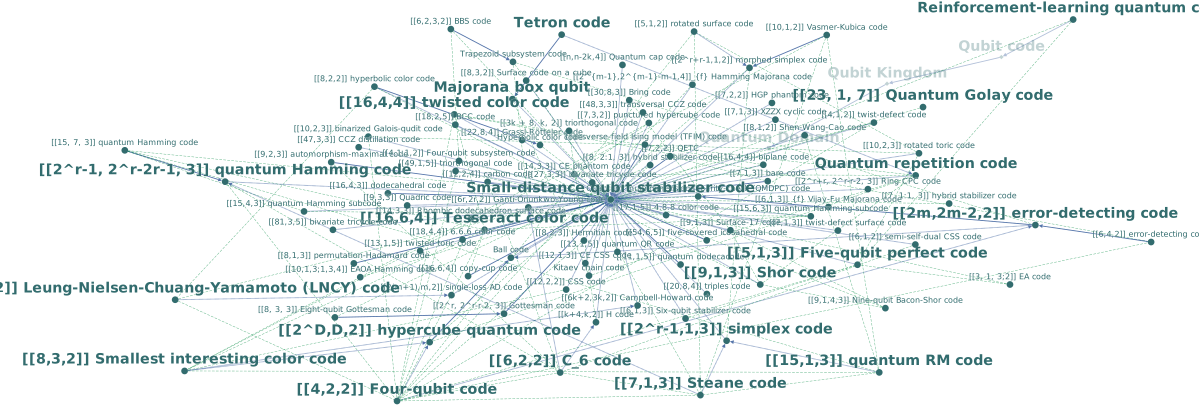
List (descendants_and_cousins): All descendants and cousins of Small-distance qubit stabilizer code.
References
- [1]
- M. Vasmer and A. Kubica, “Morphing Quantum Codes”, PRX Quantum 3, (2022) arXiv:2112.01446 DOI
- [2]
- E. B. da Silva and W. S. Soares, “Hyperbolic quantum color codes”, (2018) arXiv:1804.06382
- [3]
- N. Delfosse, “Tradeoffs for reliable quantum information storage in surface codes and color codes”, 2013 IEEE International Symposium on Information Theory 917 (2013) arXiv:1301.6588 DOI
- [4]
- H. Bombin and M. A. Martin-Delgado, “Exact topological quantum order inD=3and beyond: Branyons and brane-net condensates”, Physical Review B 75, (2007) arXiv:cond-mat/0607736 DOI
- [5]
- C. Vuillot and N. P. Breuckmann, “Quantum Pin Codes”, IEEE Transactions on Information Theory 68, 5955 (2022) arXiv:1906.11394 DOI
- [6]
- A. Y. Kitaev, “Unpaired Majorana fermions in quantum wires”, Physics-Uspekhi 44, 131 (2001) arXiv:cond-mat/0010440 DOI
- [7]
- A. Schuckert, E. Crane, A. V. Gorshkov, M. Hafezi, and M. J. Gullans, “Fault-tolerant fermionic quantum computing”, (2025) arXiv:2411.08955
- [8]
- D. Gottesman, Surviving as a Quantum Computer in a Classical World (2024) URL
- [9]
- T. Karzig et al., “Scalable designs for quasiparticle-poisoning-protected topological quantum computation with Majorana zero modes”, Physical Review B 95, (2017) arXiv:1610.05289 DOI
- [10]
- D. Litinski and F. von Oppen, “Quantum computing with Majorana fermion codes”, Physical Review B 97, (2018) arXiv:1801.08143 DOI
- [11]
- P. J. Nadkarni, S. Adonsou, G. Dauphinais, D. W. Kribs, and M. Vasmer, “Unified and Generalized Approach to Entanglement-Assisted Quantum Error Correction”, IEEE Transactions on Quantum Engineering 7, 2101132 (2026) arXiv:2411.14389 DOI
- [12]
- J. M. Koh, A. Gong, A. C. Diaconu, D. B. Tan, A. A. Geim, M. J. Gullans, N. Y. Yao, M. D. Lukin, and S. Majidy, “Entangling logical qubits without physical operations”, (2026) arXiv:2601.20927
- [13]
- A. A. Kovalev, I. Dumer, and L. P. Pryadko, “Design of additive quantum codes via the code-word-stabilized framework”, Physical Review A 84, (2011) arXiv:1108.5490 DOI
- [14]
- R. Sarkar and T. J. Yoder, “A graph-based formalism for surface codes and twists”, Quantum 8, 1416 (2024) arXiv:2101.09349 DOI
- [15]
- A. A. Kovalev and L. P. Pryadko, “Quantum Kronecker sum-product low-density parity-check codes with finite rate”, Physical Review A 88, (2013) arXiv:1212.6703 DOI
- [16]
- S. Burton, E. Durso-Sabina, and N. C. Brown, “Genons, Double Covers and Fault-tolerant Clifford Gates”, (2024) arXiv:2406.09951
- [17]
- M. B. Hastings, “A Class of Cyclic Quantum Codes”, (2025) arXiv:2509.06865
- [18]
- A. R. Calderbank, E. M. Rains, P. W. Shor, and N. J. A. Sloane, “Quantum Error Correction via Codes over GF(4)”, (1997) arXiv:quant-ph/9608006
- [19]
- C.-Y. Lai, P.-H. Liou, and Y. Ouyang, “Fault-Tolerant Quantum Error Correction for Constant-Excitation Stabilizer Codes under Coherent Noise”, (2025) arXiv:2507.10395
- [20]
- A. Paetznick et al., “Demonstration of logical qubits and repeated error correction with better-than-physical error rates”, (2024) arXiv:2404.02280
- [21]
- F. Vatan, V. P. Roychowdhury, and M. P. Anantram, “Spatially Correlated Qubit Errors and Burst-Correcting Quantum Codes”, (1997) arXiv:quant-ph/9704019
- [22]
- R. Dastbasteh and P. Lisonek, “New quantum codes from self-dual codes over F_4”, (2022) arXiv:2211.00891
- [23]
- S. Burton, “qecdb.org: Quantum Error Correction Database”, URL
- [24]
- H. Bombin, “Topological Order with a Twist: Ising Anyons from an Abelian Model”, Physical Review Letters 105, (2010) arXiv:1004.1838 DOI
- [25]
- M. Grassl and M. Roetteler, “Leveraging automorphisms of quantum codes for fault-tolerant quantum computation”, 2013 IEEE International Symposium on Information Theory 534 (2013) arXiv:1302.1035 DOI
- [26]
- A. B. Khesin, J. Z. Lu, and P. W. Shor, “Universal Graph Representation of Stabilizer Codes”, PRX Quantum 6, (2025) arXiv:2411.14448 DOI
- [27]
- V. V. Albert, “Beyond transversality: structure of Clifford circuits for CSS codes”, (2026) arXiv:2608.05688
- [28]
- P. Prabhu and B. W. Reichardt, “Distance-four quantum codes with combined postselection and error correction”, Physical Review A 110, (2024) arXiv:2112.03785 DOI
- [29]
- N. Berthusen and E. Durso-Sabina, “Simple logical quantum computation with concatenated symplectic double codes”, Quantum 10, 2195 (2026) arXiv:2510.18753 DOI
- [30]
- B. W. Reichardt et al., “Demonstration of quantum computation and error correction with a tesseract code”, (2024) arXiv:2409.04628
- [31]
- M. F. Ezerman, S. Jitman, S. Ling, and D. V. Pasechnik, “CSS-Like Constructions of Asymmetric Quantum Codes”, IEEE Transactions on Information Theory 59, 6732 (2013) arXiv:1207.6512 DOI
- [32]
- J. Haah, M. B. Hastings, D. Poulin, and D. Wecker, “Magic state distillation with low space overhead and optimal asymptotic input count”, Quantum 1, 31 (2017) arXiv:1703.07847 DOI
- [33]
- D. W. Leung, M. A. Nielsen, I. L. Chuang, and Y. Yamamoto, “Approximate quantum error correction can lead to better codes”, Physical Review A 56, 2567 (1997) arXiv:quant-ph/9704002 DOI
- [34]
- H. Hao, “Investigations on Automorphism Groups of Quantum Stabilizer Codes”, (2021) arXiv:2109.12735
- [35]
- C. Li, J. Preskill, and Q. Xu, “Transversal dimension jump for product qLDPC codes”, (2026) arXiv:2510.07269
- [36]
- D. Hangleiter, M. Kalinowski, D. Bluvstein, M. Cain, N. Maskara, X. Gao, A. Kubica, M. D. Lukin, and M. J. Gullans, “Fault-Tolerant Compiling of Classically Hard Instantaneous Quantum Polynomial Circuits on Hypercubes”, PRX Quantum 6, (2025) arXiv:2404.19005 DOI
- [37]
- N. Chancellor, A. Kissinger, S. Zohren, J. Roffe, and D. Horsman, “Graphical structures for design and verification of quantum error correction”, Quantum Science and Technology 8, 045028 (2023) arXiv:1611.08012 DOI
- [38]
- B. Zeng, H. Chung, A. W. Cross, and I. L. Chuang, “Local unitary versus local Clifford equivalence of stabilizer and graph states”, Physical Review A 75, (2007) arXiv:quant-ph/0611214 DOI
- [39]
- S. X. Cui, D. Gottesman, and A. Krishna, “Diagonal gates in the Clifford hierarchy”, Physical Review A 95, (2017) arXiv:1608.06596 DOI
- [40]
- H. Bombin, “Gauge Color Codes: Optimal Transversal Gates and Gauge Fixing in Topological Stabilizer Codes”, (2015) arXiv:1311.0879
- [41]
- B. J. Brown, N. H. Nickerson, and D. E. Browne, “Fault-tolerant error correction with the gauge color code”, Nature Communications 7, (2016) arXiv:1503.08217 DOI
- [42]
- R. Okada, “A Quantum Analog of Delsarte’s Linear Programming Bounds”, (2025) arXiv:2502.14165
- [43]
- P. Lévay and F. Holweck, “A fermionic code related to the exceptional group E \({}_{\text{8}}\)”, Journal of Physics A: Mathematical and Theoretical 51, 325301 (2018) arXiv:1801.06998 DOI
- [44]
- N. Rengaswamy, R. Calderbank, H. D. Pfister, and S. Kadhe, “Synthesis of Logical Clifford Operators via Symplectic Geometry”, 2018 IEEE International Symposium on Information Theory (ISIT) 791 (2018) arXiv:1803.06987 DOI
- [45]
- S. Bravyi and J. Haah, “Magic-state distillation with low overhead”, Physical Review A 86, (2012) arXiv:1209.2426 DOI
- [46]
- J. Haah, “Towers of generalized divisible quantum codes”, Physical Review A 97, (2018) arXiv:1709.08658 DOI
- [47]
- M. S. Kesselring, F. Pastawski, J. Eisert, and B. J. Brown, “The boundaries and twist defects of the color code and their applications to topological quantum computation”, Quantum 2, 101 (2018) arXiv:1806.02820 DOI
- [48]
- E. M. Rains, “Quantum codes of minimum distance two”, (1997) arXiv:quant-ph/9704043
- [49]
- H. Jacinto, X. Valcarce, V. Barizien, É. Gouzien, and N. Sangouard, “Exploring the landscape of compact magic-state distillation factories”, (2026) arXiv:2606.07734
- [50]
- B. Lu and K. R. Brown, “Building codes with transversal CCZ using projective geometry and SAT solvers”, (2026) arXiv:2610.09341
- [51]
- K. Betsumiya and A. Munemasa, “On triply even binary codes”, Journal of the London Mathematical Society 86, 1 (2012) arXiv:1012.4134 DOI
- [52]
- V. V. Albert, private communication, 2026
- [53]
- S. Dasu and S. Burton, “A Classification of Transversal Clifford Gates for Qubit Stabilizer Codes”, (2025) arXiv:2507.10519
- [54]
- B. Shaw, M. M. Wilde, O. Oreshkov, I. Kremsky, and D. A. Lidar, “Encoding one logical qubit into six physical qubits”, Physical Review A 78, (2008) arXiv:0803.1495 DOI
- [55]
- Qiskit Community, “Qiskit QEC framework”, URL
- [56]
- S. Vijay and L. Fu, “Quantum Error Correction for Complex and Majorana Fermion Qubits”, (2017) arXiv:1703.00459
- [57]
- E. Knill, “Quantum computing with realistically noisy devices”, Nature 434, 39 (2005) arXiv:quant-ph/0410199 DOI
- [58]
- Z. Jiang and E. G. Rieffel, “Non-commuting two-local Hamiltonians for quantum error suppression”, Quantum Information Processing 16, (2017) arXiv:1511.01997 DOI
- [59]
- H. Goto, “High-performance fault-tolerant quantum computing with many-hypercube codes”, Science Advances 10, (2024) arXiv:2403.16054 DOI
- [60]
- A. Nemec and A. Klappenecker, “Infinite Families of Quantum-Classical Hybrid Codes”, (2020) arXiv:1911.12260
- [61]
- S. Yu, Q. Chen, and C. H. Oh, “Graphical Quantum Error-Correcting Codes”, (2007) arXiv:0709.1780
- [62]
- A. M. Steane, “Simple quantum error-correcting codes”, Physical Review A 54, 4741 (1996) arXiv:quant-ph/9605021 DOI
- [63]
- A. Cross and D. Vandeth, “Small Binary Stabilizer Subsystem Codes”, (2025) arXiv:2501.17447
- [64]
- N. Delfosse and B. W. Reichardt, “Short Shor-style syndrome sequences”, (2020) arXiv:2008.05051