600-cell code[1]
Alternative Names: Hexacosichoron code, Tetraplex code, Polytetrahedron code.
Description
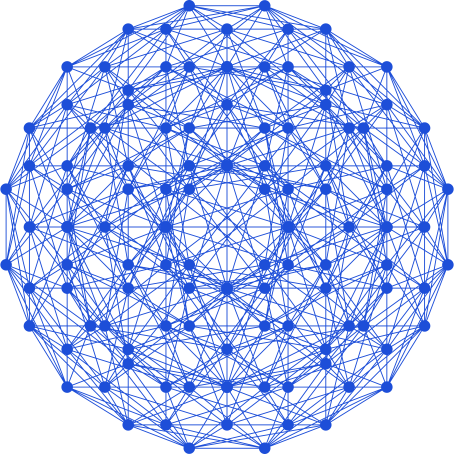
Spherical \((4,120,(3-\sqrt{5})/2)\) code whose codewords are the vertices of the 600-cell. See [2; Table 1][3; Table 3] for realizations of the 120 codewords. A realization of the 600-cell can be given in terms of icosians, which are quaternion coordinates of the 120 elements of the binary icosahedral group \(2I \cong 2.A_5\) (a.k.a. the icosian group) [5][4; Ch. 8, pg. 207].
Protection
The 600-cell code is unique up to equivalence, which follows by saturating the Boroczky bound [6,7].Notes
The 600-cell code yields improved proofs of the Bell-Kochen-Specker (BKS) theorem [2].See post by J. Baez for more details.See the corresponding Bendwavy database entry [8].Cousins
- Group-alphabet code— The 600-cell code has a quaternion-coordinate realization as the 120 elements of the binary icosahedral group \(2I \cong 2.A_5\), one of the three exceptional finite subgroups of \(SU(2)\) [5][4; Ch. 8, pg. 207].
- Dual polytope code— The 600-cell and 120-cell are dual to each other.
- 120-cell code— Vertices of a 120-cell can be split up into vertices of five 600-cells [9,10]. The 600-cell and 120-cell are dual to each other.
- Icosahedron code— A realization of the 600-cell can be done in terms of icosians, which are quaternion coordinates of the 120 elements of the binary icosahedral group \(2I \cong 2.A_5\) (a.k.a. the icosian group) [5][4; Ch. 8, pg. 207].
- Witting polytope code— The 120 vertices of the 600-cell are the unit icosians, and these icosian units, together with their multiples by \((1-\sqrt{5})/2\), form the 240 minimal vectors of a version of the \(E_8\) lattice, i.e., the Witting polytope [4; Ch. 8, pg. 210].
- 24-cell code— Vertices of a 600-cell can be split up into vertices of five 24-cells [2,9,11].
Member of code lists
Primary Hierarchy
Parents
The 600-cell is universally optimal, but it is not a spherical sharp configuration [13][12; Thm. 12.4.27].
The 600-cell code forms a spherical 11-design that is unique up to equivalence [7].
600-cell code
References
- [1]
- L. Kollros, “An Attempt to determine the twenty-seven Lines upon a Surface of the third Order, and to divide such Surfaces into Species in Reference to the Reality of the Lines upon the Surface”, Gesammelte Mathematische Abhandlungen 198 (1953) DOI
- [2]
- M. Waegell and P. K. Aravind, “Critical noncolorings of the 600-cell proving the Bell–Kochen–Specker theorem”, Journal of Physics A: Mathematical and Theoretical 43, 105304 (2010) arXiv:0911.2289 DOI
- [3]
- S. Mamone, G. Pileio, and M. H. Levitt, “Orientational Sampling Schemes Based on Four Dimensional Polytopes”, Symmetry 2, 1423 (2010) DOI
- [4]
- J. H. Conway and N. J. A. Sloane, Sphere Packings, Lattices and Groups (Springer New York, 1999) DOI
- [5]
- L. Rastanawi and G. Rote, “Towards a Geometric Understanding of the 4-Dimensional Point Groups”, (2022) arXiv:2205.04965
- [6]
- K. Boroczky, “Packing of spheres in spaces of constant curvature”, Acta Mathematica Academiae Scientiarum Hungaricae 32, 243–261 (1978)
- [7]
- P. Boyvalenkov and D. Danev, “Uniqueness of the 120-point spherical 11-design in four dimensions”, Archiv der Mathematik 77, 360 (2001) DOI
- [8]
- R. Klitzing, “Ex”, Polytopes & their Incidence Matrices URL
- [9]
- H. S. M. Coxeter, Regular Polytopes (Courier Corporation, 1973)
- [10]
- M. Waegell and P. K. Aravind, “Parity Proofs of the Kochen–Specker Theorem Based on the 120-Cell”, Foundations of Physics 44, 1085 (2014) arXiv:1309.7530 DOI
- [11]
- P. H. Schoute, Mehrdimensionale Geometrie, vol. 2: Die Polytope (1903)
- [12]
- P. Boyvalenkov, D. Danev, “Linear programming bounds”, Concise Encyclopedia of Coding Theory (Chapman and Hall/CRC, 2021), pp. 251-266 DOI
- [13]
- H. Cohn and A. Kumar, “Universally optimal distribution of points on spheres”, Journal of the American Mathematical Society 20, 99 (2006) arXiv:math/0607446 DOI
Page edit log
- Victor V. Albert (2026-06-08) — most recent
- Shubham P. Jain (2026-05-05)
- Victor V. Albert (2022-11-16)
Cite as:
“600-cell code”, The Error Correction Zoo (V. V. Albert & P. Faist, eds.), 2026. https://errorcorrectionzoo.org/c/600cell, arXiv:2606.11484