Description
Self-dual pure CSS code that is the 6.6.6 (honeycomb) color code on the torus \(\mathbb{Z}^2/3\mathbb{Z}^2\). The nine hexagonal faces each host a weight-six \(X\)-type and a weight-six \(Z\)-type stabilizer generator. The 18 qubits sit on the vertices of the tiling, i.e., on the faces of the underlying triangular lattice.
The faces of the honeycomb tiling of a torus \(\mathbb{Z}^2/L\) are three-colorable only when \(L\) lies in a particular index-three sublattice of \(\mathbb{Z}^2\). Among all such tori, this is the smallest one whose 6.6.6 color code has distance four. The smaller admissible tori give the \([[6,4,2]]\) code on three hexagons and a \([[12,4,2]]\) code on six hexagons, both of distance two.
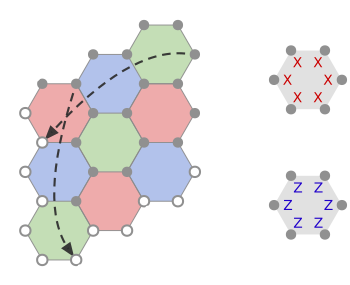
The code is simultaneously the bivariate bicycle code with \(\ell=m=3\), \(A=x+1+y^2\) and \(B=y+1+x^2\) [3], i.e., an Abelian 2BGA code over \(\mathbb{Z}_3\times\mathbb{Z}_3\).
In the bivariate-bicycle qubit ordering \(L_{3a+b},R_{3a+b}\), where the group element \(x^a y^b\) labels the left and right blocks, the stabilizer tableau of the nine \(X\)-type faces is \begin{align} \begin{smallmatrix} X & I & X & X & I & I & I & I & I & X & X & I & I & I & I & X & I & I \\ I & I & I & I & X & X & I & I & X & I & I & X & X & I & X & I & I & I \\ I & X & I & I & I & I & X & X & I & I & I & I & I & X & I & I & X & X \\ X & X & I & I & X & I & I & I & I & I & X & X & I & I & I & I & X & I \\ I & I & I & X & I & X & X & I & I & X & I & I & X & X & I & I & I & I \\ I & I & X & I & I & I & I & X & X & I & I & I & I & I & X & X & I & X \\ I & X & X & I & I & X & I & I & I & X & I & X & I & I & I & I & I & X \\ I & I & I & X & X & I & I & X & I & I & X & I & I & X & X & I & I & I \\ X & I & I & I & I & I & X & I & X & I & I & I & X & I & I & X & X & I \end{smallmatrix}~, \tag*{(1)}\end{align} listed in color classes of three: rows 1 to 3, rows 4 to 6, and rows 7 to 9 each partition all 18 qubits. The \(Z\)-type generators are supported on the same nine strings because \(C_X=C_Z\).
The classical code \(C=C_X=C_Z\) is a self-orthogonal \([18,7]\) code with weight enumerator \(1+18x^6+45x^8+45x^{10}+18x^{12}+x^{18}\). It is even but not doubly even, so this is not a divisible code.
Transversal and Permutation-Based Gates
Transversal Hadamard, since the code is a self-dual CSS code. The code is hyperbolic self-dual, so in a suitable logical basis transversal Hadamard acts as pairwise logical swaps rather than as logical Hadamards [4; Sec. III].All logical Clifford gates can be realized as two-fold transversal gates, i.e., by depth-one circuits of two-local code-preserving physical gates [5].Realizations
Superconducting circuits: syndrome extraction has been implemented for the \([[18,4,4]]\) code on a 32-qubit Kunlun device by the Wang, Song, and Deng groups [3]. The same is also shown for an \([[18,6,3]]\) code obtained by removing two check operators from the former code [3].Member of code lists
- 2D stabilizer codes
- Color codes
- Lattice qubit stabilizer codes
- Quantum codes
- Quantum codes based on homological products
- Quantum codes with transversal or permutation-based gates
- Qubit CSS codes
- Realized quantum codes
- Small-distance qubit stabilizer codes and friends
- Surface code and friends
- Topological codes
Primary Hierarchy
References
- [1]
- H. Bombin and M. A. Martin-Delgado, “Topological Quantum Distillation”, Physical Review Letters 97, (2006) arXiv:quant-ph/0605138 DOI
- [2]
- H. Bombin and M. A. Martin-Delgado, “Exact topological quantum order inD=3and beyond: Branyons and brane-net condensates”, Physical Review B 75, (2007) arXiv:cond-mat/0607736 DOI
- [3]
- K. Wang et al., “Demonstration of low-overhead quantum error correction codes”, Nature Physics (2026) arXiv:2505.09684 DOI
- [4]
- J. Haah, M. B. Hastings, D. Poulin, and D. Wecker, “Magic state distillation with low space overhead and optimal asymptotic input count”, Quantum 1, 31 (2017) arXiv:1703.07847 DOI
- [5]
- V. V. Albert, “Beyond transversality: structure of Clifford circuits for CSS codes”, (2026) arXiv:2608.05688
- [6]
- J. N. Eberhardt, F. R. F. Pereira, and V. Steffan, “Pruning qLDPC codes: Towards bivariate bicycle codes with open boundary conditions”, (2024) arXiv:2412.04181
- [7]
- Z. Liang and Y.-A. Chen, “Self-dual bivariate bicycle codes with transversal Clifford gates”, (2026) arXiv:2510.05211
Page edit log
- Victor V. Albert (2026-10-11) — most recent
- Victor V. Albert (2026-09-26)
- Victor V. Albert (2026-08-05)
Cite as:
“\([[18,4,4]]\) 6.6.6 color code”, The Error Correction Zoo (V. V. Albert & P. Faist, eds.), 2026. https://errorcorrectionzoo.org/c/stab_18_4_4, arXiv:2606.11484