Description
Self-dual doubly-even CSS code that is the 4.8.8 color code on the smallest torus, twisted in that one boundary identification is shifted by half a period [2]. Equivalently, it is the concatenated symplectic double of the \([[4,2,2]]\) code, i.e., its inner \([[8,4,2]]\) symplectic double with each \(ZX\)-dual pair of qubits encoded into an outer \([[4,2,2]]\) block [3]. Automorphisms of the \([[4,2,2]]\) seed lift through this structure to logical gates realized by qubit permutations [3].
Fattening each vertex of the \(2\times 2\) square lattice into a square yields four square faces and four octagonal faces, shown in Fig. I. The octagons are two-colored in checkerboard fashion. This gives eight faces on 16 qubits and 24 edges. Gluing the shifted pair of boundaries straight instead yields a different code.
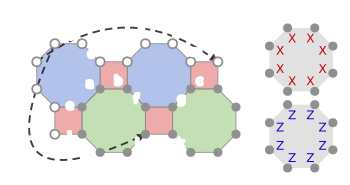
The seed is the non-CSS presentation \(\langle XZZX, ZXXZ\rangle\) of the \([[4,2,2]]\) code, whose symplectic double is an \([[8,4,2]]\) CSS code on two copies of its four qubits [3]. Qubit \(i\) of the first copy and qubit \(i\) of the second are exchanged by the \(ZX\) duality of the double. Each such pair is encoded as the two logical qubits of one \([[4,2,2]]\) block with logical operators \(\overline{X}_1=XXII\), \(\overline{Z}_1=ZIZI\), \(\overline{X}_2=XIXI\), and \(\overline{Z}_2=ZZII\) [3]. The code is isomorphic to the \(L=2\) many-hypercubes (MHC) code built from the \([[4,2,2]]\) code [3,4]. Equivalently, it is two copies of the \([[4,2,2]]\) code concatenated with the \([[4,2,2]]\) code [1].
A stabilizer tableau for the code is [3] \begin{align} \begin{smallmatrix} Z & Z & Z & Z & I & I & I & I & I & I & I & I & I & I & I & I \\ I & I & I & I & Z & Z & Z & Z & I & I & I & I & I & I & I & I \\ I & I & I & I & I & I & I & I & Z & Z & Z & Z & I & I & I & I \\ I & I & I & I & I & I & I & I & I & I & I & I & Z & Z & Z & Z \\ Z & Z & I & I & Z & I & Z & I & Z & I & Z & I & Z & Z & I & I \\ Z & I & Z & I & Z & Z & I & I & Z & Z & I & I & Z & I & Z & I \\ X & X & X & X & I & I & I & I & I & I & I & I & I & I & I & I \\ I & I & I & I & X & X & X & X & I & I & I & I & I & I & I & I \\ I & I & I & I & I & I & I & I & X & X & X & X & I & I & I & I \\ I & I & I & I & I & I & I & I & I & I & I & I & X & X & X & X \\ X & X & I & I & X & I & X & I & X & I & X & I & X & X & I & I \\ X & I & X & I & X & X & I & I & X & X & I & I & X & I & X & I \end{smallmatrix}~. \tag*{(1)}\end{align} Rows 1 to 4 are the \(Z\)-type outer stabilizers of each \([[4,2,2]]\) block. Rows 5 and 6 are the \(Z\)-type inner stabilizers inherited from the symplectic double. Rows 7 to 10 are the \(X\)-type outer stabilizers. Rows 11 and 12 are the \(X\)-type inner stabilizers.
Protection
Detects errors on up to 3 qubits and corrects errors on 1 qubit.Encoding
A fault-tolerant, bare-ancilla state-preparation procedure for the logical \(|\overline{0}\rangle\) and \(|\overline{+}\rangle\) states is given in [3].Transversal and Permutation-Based Gates
SWAP-transversal gates lifted from automorphisms of the seed \([[4,2,2]]\) code, together with the \(ZX\)-duality gates \(\overline{H}_\tau\) and \(\overline{S}_\tau\) inherited from the symplectic double, give \(216\) unique logical gates [3]. Adding a global logical phase gate gives the group \((A_8\times A_8)\rtimes(C_2\times C_2)\subset Sp(8,2)\) [3]. Only one of the \(20\) \(ZX\)-dualities admits a phase-type gate, and the permissible qubit permutations \(C_2\times S_4\) act non-faithfully with image \(D_6\). Together with all two-qubit entangling gates, they generate the logical orthogonal subgroup \(\Omega^{+}(8,2)\) [5]. Adjoining a targeted logical \(S\) on a single logical qubit yields all of \(Sp(8,2)\) [3,6].Gates
Any logical Clifford circuit on the four logical qubits can be compiled using the SWAP-transversal gateset together with at most a small number of logical phase-gate injections [3]. The injections are performed via state teleportation [3].Fault Tolerance
Single-shot distance-three fault-tolerant error correction with 12 nonadaptive stabilizer measurements in six rounds, or with eight or ten adaptively chosen measurements in four rounds [1; Thm. 7].The transversal phase gate on the inner \([[8,4,2]]\) symplectic double code requires performing logical global phase gates on each \([[4,2,2]]\) block to remain SWAP-transversal on the concatenated code [3; Appx. D.7]. This can be implemented fault-tolerantly but requires two-qubit gates [3; Appx. D.7].An automorphism gate that swaps logical qubits between different \([[4,2,2]]\) blocks requires additional \([[4,2,2]]\) ancilla blocks to implement fault-tolerantly [3; Appx. D.8].Realizations
Neutral atom arrays: state initialization of the \([[16,4,4]]\) twisted color code on a device by Infleqtion [7].Cousins
- \([[4,2,2]]\) Four-qubit code— The \([[16,4,4]]\) twisted color code is obtained by concatenating the inner symplectic double of the \([[4,2,2]]\) code with outer \([[4,2,2]]\) blocks [3]. It is isomorphic to the \(L=2\), \([[4,2,2]]\)-based many-hypercubes code [3].
- \([[6,4,2]]\) error-detecting code— The \([[16,4,4]]\) code is the \(C_4\)-based (\([[4,2,2]]\)-based) analogue of the original many-hypercubes codes, which are built from the \([[6,4,2]]\) code instead [3,4].
- \([[16,6,4]]\) Tesseract color code— The \([[16,4,4]]\) code is obtained from the tesseract color code by promoting one \(X\)-type and one \(Z\)-type weight-four logical operator to stabilizers [1,2]. Equivalently, it is obtained by fixing the weight-four gauge operators of the \([[16,4,2,4]]\) tesseract subsystem code [8].
- \([[16,4,4]]\) biplane code— The \([[16,4,4]]\) biplane code and the \([[16,4,4]]\) twisted color code are the two self-dual CSS gauge fixings of the \([[16,4,2,4]]\) tesseract subsystem code [8]. They are obtained by promoting the weight-six and the weight-four gauge operators, respectively.
Member of code lists
- 2D stabilizer codes
- Color codes
- Concatenated quantum codes
- Lattice qubit stabilizer codes
- Quantum codes
- Quantum codes based on homological products
- Quantum codes with fault-tolerant gadgets
- Quantum codes with transversal or permutation-based gates
- Qubit CSS codes
- Realized quantum codes
- Small-distance qubit stabilizer codes and friends
- Surface code and friends
- Topological codes
Primary Hierarchy
References
- [1]
- N. Delfosse and B. W. Reichardt, “Short Shor-style syndrome sequences”, (2020) arXiv:2008.05051
- [2]
- P. Prabhu and B. W. Reichardt, “Distance-four quantum codes with combined postselection and error correction”, Physical Review A 110, (2024) arXiv:2112.03785 DOI
- [3]
- N. Berthusen and E. Durso-Sabina, “Simple logical quantum computation with concatenated symplectic double codes”, Quantum 10, 2195 (2026) arXiv:2510.18753 DOI
- [4]
- H. Goto, “High-performance fault-tolerant quantum computing with many-hypercube codes”, Science Advances 10, (2024) arXiv:2403.16054 DOI
- [5]
- N. P. Breuckmann and S. Burton, “Fold-Transversal Clifford Gates for Quantum Codes”, Quantum 8, 1372 (2024) arXiv:2202.06647 DOI
- [6]
- V. V. Albert, “Beyond transversality: structure of Clifford circuits for CSS codes”, (2026) arXiv:2608.05688
- [7]
- R. Rines et al., “Demonstration of a Logical Architecture Uniting Motion and In-Place Entanglement”, (2026) arXiv:2509.13247
- [8]
- B. W. Reichardt et al., “Demonstration of quantum computation and error correction with a tesseract code”, (2024) arXiv:2409.04628
- [9]
- Z. Liang and Y.-A. Chen, “Self-dual bivariate bicycle codes with transversal Clifford gates”, (2026) arXiv:2510.05211
Page edit log
- Victor V. Albert (2026-10-11) — most recent
- Victor V. Albert (2026-09-26)
- Victor V. Albert (2026-09-20)
- Victor V. Albert (2026-08-24)
- Victor V. Albert (2026-08-08)
- Victor V. Albert (2026-07-08)
Cite as:
“\([[16,4,4]]\) twisted color code”, The Error Correction Zoo (V. V. Albert & P. Faist, eds.), 2026. https://errorcorrectionzoo.org/c/stab_16_4_4, arXiv:2606.11484