Here is a list of operator-algebra qubit codes that are not ordinary (i.e., subspace) qubit codes. Subsystem stabilizer qubit codes are included here and in Subsystem stabilizer codes.
| Code | Description |
|---|---|
| 2D subsystem color code | A subsystem version of the 2D color code. The original topological subsystem-code example is defined on the Union Jack lattice [1]; the square-octagon-lattice hypergraph construction of [2] reproduces the same code from a complementary viewpoint. |
| 3D Bacon-Shor code | Generalization of the Bacon-Shor code to three dimensions that was conjectured to be a self-correcting memory. It is defined on a cubic lattice and admits sheet-like stabilizer generators. |
| 3D Kitaev honeycomb code | 3D subsystem stabilizer code whose Hamiltonian is a 3D generalization of the Kitaev honeycomb model. One of the phases realized by the 3D Kitaev honeycomb Hamiltonian is that of the 3D fermionic surface code [3]. |
| 3D subsystem color code | A subsystem version of the 3D color code defined on a 3-colex. |
| 3D subsystem surface code | Subsystem generalization of the surface code on a 3D cubic lattice with gauge-group generators of weight at most three. |
| Bacon-Shor code | Subsystem CSS code defined on an \(m_1 \times m_2\) lattice of qubits that generalizes the \([[9,1,3]]\) (subspace) Shor code. It is said to be symmetric when \(m_1=m_2\), and asymmetric otherwise. |
| Bravyi-Bacon-Shor (BBS) code | A CSS subsystem stabilizer code generalizing Bacon-Shor codes to a larger set of qubit geometries. Defined through a binary matrix \(A\) such that physical qubits live on sites \((i,j)\) whenever \(A_{i,j}=1\). The gauge group is generated by 2-qubit operators, including \(XX\) interactions between any two qubits sharing a column in \(A\), and \(ZZ\) interactions between any two qubits sharing a row. |
| CSS-Plaquette code | Generalization of the Bacon-Shor code to three dimensions, defined on a cubic lattice and admitting string-like stabilizer generators. |
| Capped color code (CCC) | A non-geometrically local subsystem color code consisting of two layers of 2D color code stacked together and topped (or capped) by a single qubit. Gauge fixing yields two types of codes, capped color codes in H or T form. Layers of 2D color codes can also be stacked together in a recursive construction, yielding recursive capped color codes (RCCCs). |
| Compass code | Subspace or subsystem CSS code defined by gauge-fixing the Bacon-Shor code, i.e., the code whose gauge group consists of terms in the compass model Hamiltonian [4–6] on a square lattice. Families of random codes perform well against biased noise and spatially dependent (i.e., asymmetric) noise. |
| Doubled color code | Family of \([[2t^3+8t^2+6t-1,1,2t+1]]\) subsystem color codes (with \(t\geq 1\)), constructed using a generalization of the doubling transformation [7], that admit a Clifford + \(T\) transversal gate set using gauge fixing. |
| Generalized five-squares code | Member of a family of subsystem codes that are generalizations [8,9] of a code defined on a three-valent hypergraph associated with the five-squares lattice [2]. The original five-squares code is a 2D topological subsystem code with local two-qubit gauge generators; on a torus, it encodes two logical qubits [2]. |
| Heavy-hexagon code | Subsystem stabilizer code on the heavy-hexagonal point set that combines Bacon-Shor and surface-code stabilizers. Has parameters \([[d^2,1,d]]\), with \(d\) data qubits along each row and column of the lattice [10]. A distance-\(d\) implementation additionally requires \((d+1)(d-1)/2\) syndrome-measurement qubits and \(d(d-1)\) flag qubits, for a total of \((5d^2-2d-1)/2\) qubits. The heavy-hexagonal point set allows for low degree (at most 3) connectivity between all the data and ancilla qubits, which is suitable for fixed-frequency transmon qubits subject to frequency collision errors. The code can be split into a surface and a Bacon-Shor code, with the idling qubits of one code serving as the physical qubits of the other [11]. |
| Hybrid convolutional code | A quantum convolutional code which protects both quantum and classical information. |
| Hybrid qubit code | A qubit code which stores both quantum and classical information. Usually denoted as \(((n,K:M))\) or \(((n,K:M,d))\), where \(K\) is the dimension of the underlying quantum code, \(M\) is the size of the classical code, and \(d\) is the distance. |
| Hybrid stabilizer code | A qubit stabilizer code which stores both quantum and classical information. Usually denoted as \([[n,k:c]]\) or \([[n,k:c,d]]\), where \(k\) (\(c\)) is the number of encoded qubits (classical bits), and where \(d\) is the distance. |
| Kitaev honeycomb code | Subsystem qubit stabilizer code underlying the Kitaev honeycomb model [2,12]. Its gauge generators are the two-qubit \(XX\), \(YY\), and \(ZZ\) link operators on the three edge types of the honeycomb lattice [2; Sec. 3.2]. Its stabilizer group is generated by loop operators, and syndrome extraction can be reduced to ordered measurements of the two-qubit link operators [2; Sec. 3.2]. This is the \(q=2\) instance of the \(\mathbb{Z}_q^{(1)}\) subsystem code and does not encode any logical qubits [2][13; Sec. 7.3]. |
| Majorana subsystem stabilizer code | Subsystem stabilizer code whose gauge group is generated by products of Majorana operators. Logical information is encoded in physical fermionic modes, with some encoded degrees of freedom designated as gauge qubits. |
| Majorana-XYZ code | Non-CSS subsystem qubit stabilizer code on a periodic \(L\times L\) triangular lattice whose gauge group is generated by weight-three triangle operators, each placing \(Z\), \(X\), and \(Y\) on the corners of one plaquette. For each Pauli type, straight-line loops along one lattice direction commute with every triangle operator, and the product of two adjacent parallel loops is itself a product of triangle operators. Such double loops generate the stabilizer group and single loops are the bare logical operators, so the code encodes one logical qubit with distance \(L\) using only three-qubit checks [14]. |
| OA Bacon-Shor code | Family of OA qubit stabilizer codes derived from Bacon-Shor subsystem codes by using their extra gauge structure to store classical information. |
| OA qubit code | An OAQECC family that encompasses ordinary (i.e., subspace) qubit codes, subsystem qubit codes, and hybrid qubit codes using an operator-algebraic framework. |
| Operator-algebra (OA) qubit stabilizer code | An OAQECC in which the commutant \(\mathcal{A}'\) of the logical algebra \(\mathcal{A}\) arises as the group algebra of a subgroup \(\mathsf{G}\) of the \(n\)-qubit Pauli group \(\mathsf{P}_n\). |
| Sarvepalli-Brown subsystem code | Member of a family of non-CSS subsystem codes constructed from hypergraphs that satisfy certain assumptions [8; Construction C]. |
| Subsystem Hypergraph Product Simplex (SHYPS) code | Family of quantum LDPC codes obtained by combining the subsystem hypergraph product code construction with classical simplex codes. The results are CSS subsystem codes with weight-three gauge generators and code parameters \([[n=(2^r − 1)^2, k=r^2, d=2^{r-1}]]\) for \(r \geq 3\). |
| Subsystem color code | A subsystem version of the color code. |
| Subsystem holographic code | A holographic tensor-network code constructed out of alternating isometries of the five-qubit and \([[4,1,1,2]]\) Bacon-Shor codes. |
| Subsystem homological code | A subsystem CSS code that is a subsystem version of the homological code, defined on cellulations of manifolds in arbitrary dimensions. Gauge-group generators are of lower weight than the stabilizers of the corresponding surface code, enabling fault-tolerant syndrome extraction with simpler circuits. The stabilizer group may contain generators of unbounded weight, distinguishing these codes from stabilizer codes with bounded-weight generators for which some logical qubits were re-assigned to be gauge qubits. |
| Subsystem homological product code | A CSS subsystem code constructed from a product of two (subspace) CSS codes. The case for qubits is formulated below, but these codes have also been extended to Galois qudits [15]. |
| Subsystem hyperbolic surface code | Subsystem generalization of the surface code on a 2D hyperbolic tessellation with gauge-group generators of weight at most three. An \(\{r,4\}\) hyperbolic tessellation with \(E\) edges yields a \([[3E/2,(1/2-2/r)E+2,(1-2/r)E,d]]\) subsystem code. |
| Subsystem hypergraph product (SHP) code | A CSS subsystem version of the generalized Shor code that has the same parameters as the subspace version, but requires fewer stabilizer measurements, resulting in a simpler error recovery routine. The code can also be thought of as a subsystem version of an HGP code because two such codes reduce to an HGP code upon gauge fixing [16; Sec. III]. The code can be obtained from a generalized Shor code by removing certain stabilizers that do not affect the code distance. |
| Subsystem lifted-product (SLP) code | Member of a family of subsystem CSS codes constructed from a subsystem hypergraph product of a lifted binary linear code. |
| Subsystem qubit CSS code | Subsystem qubit stabilizer code which admits a set of gauge-group generators which consist of either all-\(Z\) or all-\(X\) Pauli strings. This ensures that the code’s stabilizer group is also CSS. |
| Subsystem qubit code | Subsystem QECC encoding into a \(2^n\)-dimensional (i.e., \(n\)-qubit) Hilbert space. |
| Subsystem qubit stabilizer code | A stabilizer code with some of its logical qubits denoted as gauge qubits and not used for storage of logical information. Note that this doesn’t lead to new codes but does lead to new error correction and fault tolerance procedures. Subsystem codes are denoted by \([[n,k,g,d]]\), similar to stabilizer codes, but with an extra parameter \(g\) denoting the number of gauge qubits. |
| Subsystem rotated surface code | Subsystem version of the rotated surface code. |
| Subsystem spacetime circuit code | Subsystem stabilizer code obtained from a spacetime circuit code by gauging out logical operators that correspond to circuit faults with trivial effect [17; Sec. 5.4]. In the original circuit-to-code construction, each circuit element is replaced by low-weight gauge generators enforcing its input-output relations, yielding subsystem codes from restricted Clifford postselection circuits [18]. |
| Subsystem surface code | Subsystem version of the surface code defined on a square lattice with qubits placed at every vertex and center of every edge. Its gauge checks are weight-three triangle operators of type \(XXX\) and \(ZZZ\) [19]. |
| Tetron subsystem code | Member of a family of Majorana subsystem stabilizer codes on \(n\) tetrons obtained from an \([[n,k_b,d_b]]\) qubit stabilizer code and an \([n,k,d_c]\) classical binary code. The qubit code’s Pauli operators become weight-two Majorana operators on the tetrons, and the classical code’s parity checks become stabilizers that are products of four-Majorana tetron parities. A tetron parity flips only under an odd-weight (fermionic) error, so these checks detect such errors, while tetron parities not fixed by them are gauge operators rather than further stabilizer generators [20]. |
| Three-fermion (3F) subsystem code | 2D subsystem stabilizer code whose low-energy excitations realize the three-fermion anyon theory [21–23]. One version uses two qubits at each site [13], while other manifestations utilize a single qubit per site and only weight-two (two-body) interactions [1,22]. All are expected to be equivalent to each other via a local constant-depth Clifford circuit. |
| Trapezoid subsystem code | A member of a family of BBS codes with weight-two (two-body) gauge generators designed to suppress errors in adiabatic quantum computation. |
| \([[4,1,1,2]]\) Four-qubit subsystem code | Error-detecting four-qubit subsystem stabilizer code encoding one logical qubit and one gauge qubit. |
| \([[6,2,3,2]]\) BBS code | Error-detecting six-qubit BBS subsystem code with parameters \([[6,2,3,2]]\) that can suppress errors in adiabatic quantum computation [24]. |
| \([[7, 1:1, 3]]\) hybrid stabilizer code | A distance-three seven-qubit hybrid stabilizer code storing one qubit and one classical bit. Admits a stabilizer generator set with a weight-two generator, which delineates the underlying classical code [25; Eq. (3)]. |
| \([[8, 2:1, 3]]\) hybrid stabilizer code | A code obtained from the \([[8,3,3]]\) Gottesman code by using one of its logical qubits as a classical bit. One can also use two logical qubits as classical bits, obtaining an \([[8,1:2,3]]\) hybrid stabilizer code. |
| \([[9,1,4,3]]\) Nine-qubit Bacon-Shor code | Error-correcting nine-qubit subsystem stabilizer code encoding one logical qubit and four gauge qubits. There are exactly four inequivalent CSS gauge fixings of the code, including the Shor code and the surface-17 code [26]. |
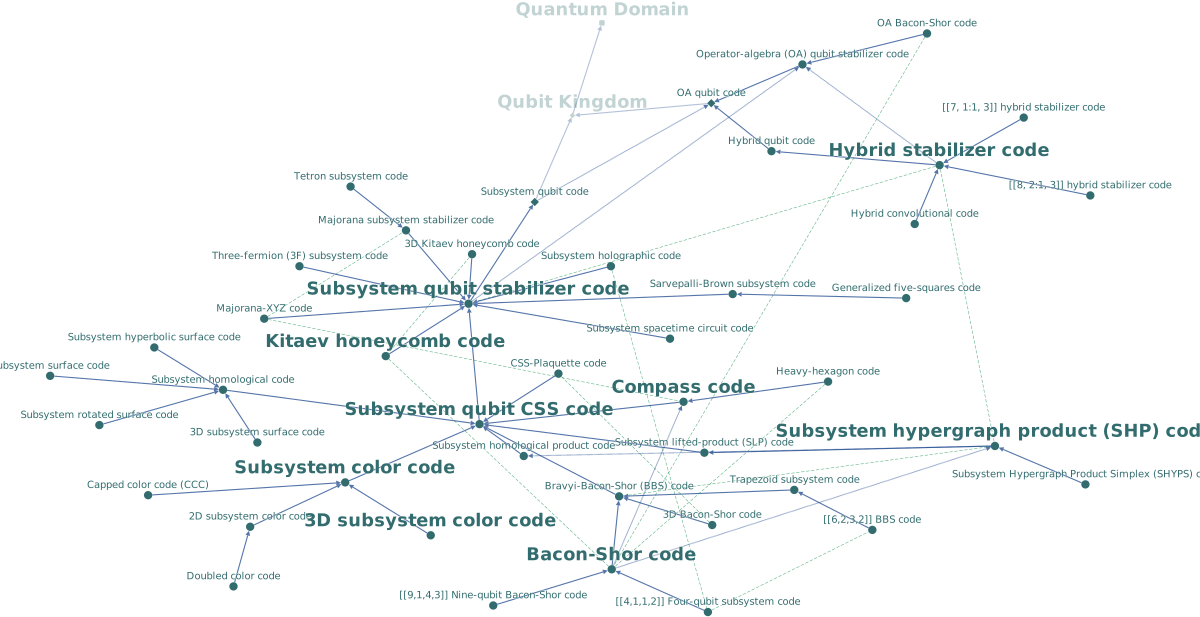
List: Codes that are descendants of OA qubit code and not descendants of Qubit code.
References
- [1]
- H. Bombin, “Topological subsystem codes”, Physical Review A 81, (2010) arXiv:0908.4246 DOI
- [2]
- M. Suchara, S. Bravyi, and B. Terhal, “Constructions and noise threshold of topological subsystem codes”, Journal of Physics A: Mathematical and Theoretical 44, 155301 (2011) arXiv:1012.0425 DOI
- [3]
- S. Mandal and N. Surendran, “Exactly solvable Kitaev model in three dimensions”, Physical Review B 79, (2009) arXiv:0801.0229 DOI
- [4]
- K. I. Kugel’ and D. I. Khomskiĭ, “The Jahn-Teller effect and magnetism: transition metal compounds”, Soviet Physics Uspekhi 25, 231 (1982) DOI
- [5]
- J. Dorier, F. Becca, and F. Mila, “Quantum compass model on the square lattice”, Physical Review B 72, (2005) arXiv:cond-mat/0501708 DOI
- [6]
- Z. Nussinov and J. van den Brink, “Compass and Kitaev models – Theory and Physical Motivations”, (2013) arXiv:1303.5922
- [7]
- K. Betsumiya and A. Munemasa, “On triply even binary codes”, Journal of the London Mathematical Society 86, 1 (2012) arXiv:1012.4134 DOI
- [8]
- P. Sarvepalli and K. R. Brown, “Topological subsystem codes from graphs and hypergraphs”, Physical Review A 86, (2012) arXiv:1207.0479 DOI
- [9]
- V. V. Gayatri and P. K. Sarvepalli, “Decoding Algorithms for Hypergraph Subsystem Codes and Generalized Subsystem Surface Codes”, (2018) arXiv:1805.12542
- [10]
- C. Chamberland, G. Zhu, T. J. Yoder, J. B. Hertzberg, and A. W. Cross, “Topological and Subsystem Codes on Low-Degree Graphs with Flag Qubits”, Physical Review X 10, (2020) arXiv:1907.09528 DOI
- [11]
- B. Hetényi and J. R. Wootton, “Creating Entangled Logical Qubits in the Heavy-Hex Lattice with Topological Codes”, PRX Quantum 5, (2024) arXiv:2404.15989 DOI
- [12]
- A. Kitaev, “Anyons in an exactly solved model and beyond”, Annals of Physics 321, 2 (2006) arXiv:cond-mat/0506438 DOI
- [13]
- T. D. Ellison, Y.-A. Chen, A. Dua, W. Shirley, N. Tantivasadakarn, and D. J. Williamson, “Pauli topological subsystem codes from Abelian anyon theories”, Quantum 7, 1137 (2023) arXiv:2211.03798 DOI
- [14]
- T. Busse and L. Toikka, “Majorana-XYZ subsystem code”, (2026) arXiv:2603.26311
- [15]
- W. Zeng and L. P. Pryadko, “Minimal distances for certain quantum product codes and tensor products of chain complexes”, Physical Review A 102, (2020) arXiv:2007.12152 DOI
- [16]
- M. Li and T. J. Yoder, “A Numerical Study of Bravyi-Bacon-Shor and Subsystem Hypergraph Product Codes”, (2020) arXiv:2002.06257
- [17]
- N. Delfosse and A. Paetznick, “Spacetime codes of Clifford circuits”, (2023) arXiv:2304.05943
- [18]
- D. Bacon, S. T. Flammia, A. W. Harrow, and J. Shi, “Sparse Quantum Codes From Quantum Circuits”, IEEE Transactions on Information Theory 63, 2464 (2017) arXiv:1411.3334 DOI
- [19]
- S. Bravyi, G. Duclos-Cianci, D. Poulin, and M. Suchara, “Subsystem surface codes with three-qubit check operators”, (2013) arXiv:1207.1443
- [20]
- S. Kundu and B. Reichardt, “Majorana subsystem qubit codes that also correct odd-weight errors”, New Journal of Physics 26, 073029 (2024) DOI
- [21]
- E. Rowell, R. Stong, and Z. Wang, “On classification of modular tensor categories”, (2009) arXiv:0712.1377
- [22]
- H. Bombin, M. Kargarian, and M. A. Martin-Delgado, “Interacting anyonic fermions in a two-body color code model”, Physical Review B 80, (2009) arXiv:0811.0911 DOI
- [23]
- H. Bombin, G. Duclos-Cianci, and D. Poulin, “Universal topological phase of two-dimensional stabilizer codes”, New Journal of Physics 14, 073048 (2012) arXiv:1103.4606 DOI
- [24]
- Z. Jiang and E. G. Rieffel, “Non-commuting two-local Hamiltonians for quantum error suppression”, Quantum Information Processing 16, (2017) arXiv:1511.01997 DOI
- [25]
- A. Nemec and A. Klappenecker, “Infinite Families of Quantum-Classical Hybrid Codes”, (2020) arXiv:1911.12260
- [26]
- A. Cross and D. Vandeth, “Small Binary Stabilizer Subsystem Codes”, (2025) arXiv:2501.17447