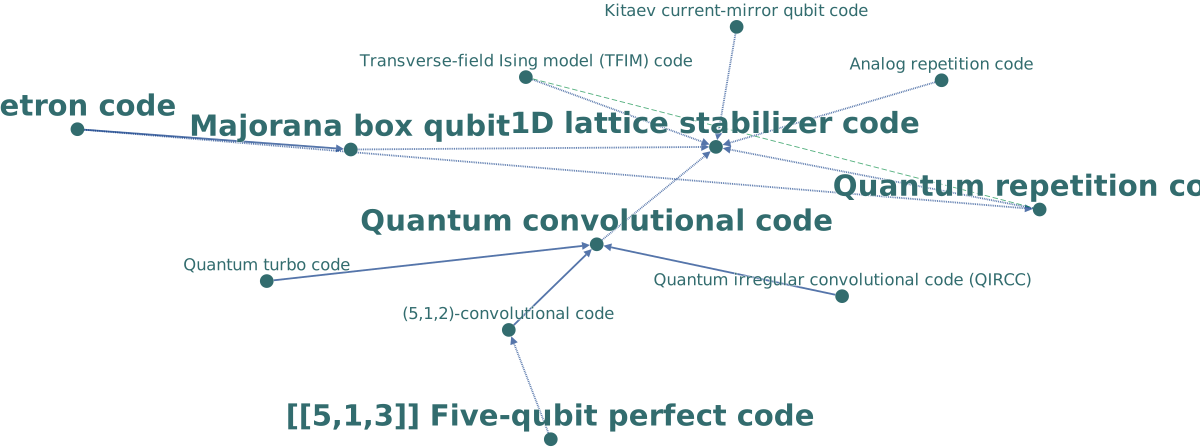
Here is a list of 1D stabilizer codes.
| Code | Description |
|---|---|
| 1D lattice stabilizer code | Lattice stabilizer code in one Euclidean dimension, using either the ordinary block notion of locality or the fermionic/Majorana notion of locality. |
| Analog repetition code | An \([[n,1]]_{\mathbb{R}}\) analog stabilizer version of the quantum repetition code, encoding the position states of one mode into an odd number \(n\) of modes. |
| Kitaev current-mirror qubit code | Member of the family of \([[2n,(0,2),(2,n)]]_{\mathbb{Z}}\) homological rotor codes storing a logical qubit on a thin Möbius strip. The ideal code can be obtained from a Josephson-junction [1] system [2]. |
| Majorana box qubit | A family of Majorana stabilizer codes obtained by fixing the total fermion parity of \(n\) fermionic modes, equivalently \(2n\) Majorana zero modes, within the ground-state subspace of \(n\) Kitaev Majorana chain Hamiltonians. The resulting positive-parity subspace encodes \(n-1\) logical qubits and has Majorana distance \(2\). |
| Quantum convolutional code | 1D translationally invariant qubit stabilizer code whose stabilizer group can be partitioned into constant-size subsets of constant support and of constant overlap between neighboring sets. Initially formulated as a quantum analogue of convolutional codes, which were designed to protect a continuous and never-ending stream of information. Precise formulations sometimes begin with a finite-dimensional lattice, with the intent to take the thermodynamic limit; logical dimension can be infinite as well. |
| Quantum irregular convolutional code (QIRCC) | Quantum convolutional code whose stabilizer group consists of different constant-size subsets. |
| Quantum repetition code | Encodes \(1\) qubit into \(n\) qubits according to \(|0\rangle\to|\phi_0\rangle^{\otimes n}\) and \(|1\rangle\to|\phi_1\rangle^{\otimes n}\). The code is called a bit-flip code when \(|\phi_i\rangle = |i\rangle\), and a phase-flip code when \(|\phi_0\rangle = |+\rangle\) and \(|\phi_1\rangle = |-\rangle\). This repetition-style encoding does not clone an arbitrary quantum state; instead, it extends the copying of computational-basis states linearly to entangled codewords [3; Ch. 2]. |
| Quantum turbo code | A quantum version of the turbo code, obtained from an interleaved serial quantum concatenation [4; Def. 30] of quantum convolutional codes. The interleaver induces long-range entanglement and can increase the minimum distance relative to the constituent convolutional codes [5]. |
| Tetron code | A \([[2,1,2]]_{f}\) Majorana box qubit encoding a logical qubit into four Majorana modes, equivalently into the fixed-total-parity sector of two physical fermionic modes. Four Majorana zero modes are the smallest aggregate that supports a qubit in a fixed fermion-parity sector [6]. This code can be concatenated with various qubit codes such as surface codes and color codes. Four-boundary Majorana surface-code patches are logical tetrons, i.e., higher-distance analogues of this physical tetron block [7]. |
| Transverse-field Ising model (TFIM) code | A 1D translationally invariant stabilizer code whose encoding is a constant-depth circuit of nearest-neighbor gates on alternating even and odd bonds that consist of transverse-field Ising Hamiltonian interactions. The code allows for perfect state transfer of arbitrary distance using local operations and classical communications (LOCC). |
| \((5,1,2)\)-convolutional code | Family of quantum convolutional codes that are 1D lattice generalizations of the five-qubit perfect code, with the former’s lattice-translation symmetry being the extension of the latter’s cyclic permutation symmetry. |
| \([[5,1,3]]\) Five-qubit perfect code | Five-qubit cyclic stabilizer code that is the smallest qubit stabilizer code to correct a single-qubit error. |
List (descendants): All descendants of 1D lattice stabilizer code.
References
- [1]
- S. M. Girvin, “Circuit QED: superconducting qubits coupled to microwave photons”, Quantum Machines: Measurement and Control of Engineered Quantum Systems 113 (2014) DOI
- [2]
- C. Vuillot, A. Ciani, and B. M. Terhal, “Homological Quantum Rotor Codes: Logical Qubits from Torsion”, Communications in Mathematical Physics 405, (2024) arXiv:2303.13723 DOI
- [3]
- D. Gottesman, Surviving as a Quantum Computer in a Classical World (2024) URL
- [4]
- D. Poulin, J.-P. Tillich, and H. Ollivier, “Quantum serial turbo-codes”, (2009) arXiv:0712.2888
- [5]
- A. J. Ferris and D. Poulin, “Tensor Networks and Quantum Error Correction”, Physical Review Letters 113, (2014) arXiv:1312.4578 DOI
- [6]
- T. Karzig et al., “Scalable designs for quasiparticle-poisoning-protected topological quantum computation with Majorana zero modes”, Physical Review B 95, (2017) arXiv:1610.05289 DOI
- [7]
- D. Litinski and F. von Oppen, “Quantum computing with Majorana fermion codes”, Physical Review B 97, (2018) arXiv:1801.08143 DOI