Here is a list of 4D stabilizer codes.
| Code | Description |
|---|---|
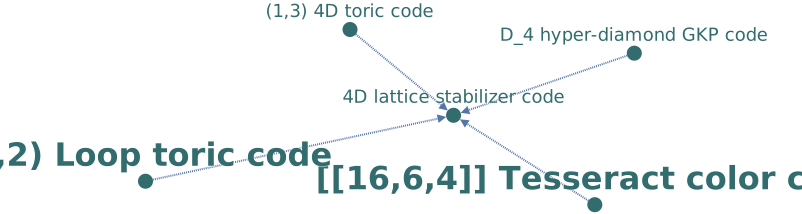
| 4D lattice stabilizer code | Lattice stabilizer code in four Euclidean dimensions, using either the ordinary block notion of locality or the fermionic/Majorana notion of locality. |
| \((1,3)\) 4D toric code | A generalization of the Kitaev surface code defined on a 4D lattice. The code is called a \((1,3)\) toric code because it admits 1D \(Z\)-type and 3D \(X\)-type logical operators. In the hypercubic lattice version, qubits are placed on edges, each \(Z\)-type stabilizer generator is supported on cubes on the boundary of a hypercube, and \(X\)-type stabilizers are placed on the edges neighboring every vertex [1]. |
| \((2,2)\) Loop toric code | A generalization of the Kitaev surface code defined on a 4D lattice. The code is called a \((2,2)\) toric code because it admits 2D membrane \(Z\)-type and \(X\)-type logical operators. Both types of operators create 1D (i.e., loop) excitations at their edges. The code serves as a self-correcting quantum memory [2,3]. |
| \(D_4\) hyper-diamond GKP code | Two-mode GKP qubit-into-oscillator code based on the \(D_4\) hyper-diamond lattice [4]. |
| \([[16,6,4]]\) Tesseract color code | A (hyperbolic self-dual CSS) doubly-even 4D color code defined on a tesseract, with stabilizer generators of both types supported on each cube. A \([[16,4,2,4]]\) tesseract subsystem code can be obtained from this code by using two logical qubits as gauge qubits [5]. |
List (descendants): All descendants of 4D lattice stabilizer code.
References
- [1]
- T. Jochym-O’Connor and T. J. Yoder, “Four-dimensional toric code with non-Clifford transversal gates”, Physical Review Research 3, (2021) arXiv:2010.02238 DOI
- [2]
- E. Dennis, A. Kitaev, A. Landahl, and J. Preskill, “Topological quantum memory”, Journal of Mathematical Physics 43, 4452 (2002) arXiv:quant-ph/0110143 DOI
- [3]
- R. Alicki, M. Horodecki, P. Horodecki, and R. Horodecki, “On thermal stability of topological qubit in Kitaev’s 4D model”, (2008) arXiv:0811.0033
- [4]
- B. Royer, S. Singh, and S. M. Girvin, “Encoding Qubits in Multimode Grid States”, PRX Quantum 3, (2022) arXiv:2201.12337 DOI
- [5]
- B. W. Reichardt et al., “Demonstration of quantum computation and error correction with a tesseract code”, (2024) arXiv:2409.04628